


Page 83 - Australian Motorcycle News (January 2020)
P. 83
Circus a much faster and more competitive
                                                                                                 alternative to their elderly British singles.
                                                                                                    The Linto 500 was unveiled in November 1967,
                                                                                                 and to speed up the project and cut down on
                                                                                                 costs via the use of already available components,
                                                                                                 Tonti’s design utilised several Aermacchi parts
                                                                                                 in its construction – sensible, really, given that
                                                                                                 the Harley-owned factory was literally a stone’s
                                                                                                 throw from Premoli’s Varese car workshop where
                                                                                                 the project was conceived. And that by then the
                                                                                                 fleet little pushrod singles had earned a name for
                                                                                                 themselves as reliable and competitive privateer
                                                                                                 mounts in the 250/350cc classes.
       3                               4                                                            But by then Tonti was working for Moto Guzzi,
                                                                                                 which in 1967 had finally gone bust and been
                                                                                                 taken over by SEIMM, which decided to fire
                                        8                                                        Giulio Cesare Carcano, the legendary designer of
                                                                                                 all Guzzi’s landmark postwar products. In 1968
                                                                                                 Tonti was hired to replace him, and managed
                                                                                                 to convince the beancounters to sanction the
                                                                                                 development of a sportier version of the transverse
                                                                                                 V-twin 700cc V7 model which Carcano had
                                                                                                 developed from the basis of an engine he’d built in
                                                                                                 1960 to power a small three-wheeled truck.
                                                                                                    Assisted by Carcano’s disciple Umberto
                                                                                                 Todero, Tonti transformed the placid V7 into a
                                                                                                 genuine high-performance motorcycle, although
                                                                                                 development work was interrupted by labour
                                                                                                 unrest which saw the Mandello del Lario factory
                                                                                                 picketed. Refusing to accept the delay, Tonti
                                                                                                 was helped by Todero and some experimental
                                                                                                 department mechanics to load a set of engine
                                                                                                 castings and a stack of chrome-moly steel tubes
                                                                                                 late at night into a van to whisk them away to
                                                                                                 his home basement workshop. Weeks later the


         King joining Brambilla in a three-man team.
         McIntyre finished fifth in the World series, King                   THE LINTO 500
         eighth and Brambilla 10th, while the light, good-          The bloke’s 500cc grand prix racer was as fast as it was frustrating…
         handling twin beat the MV Agusta four to win
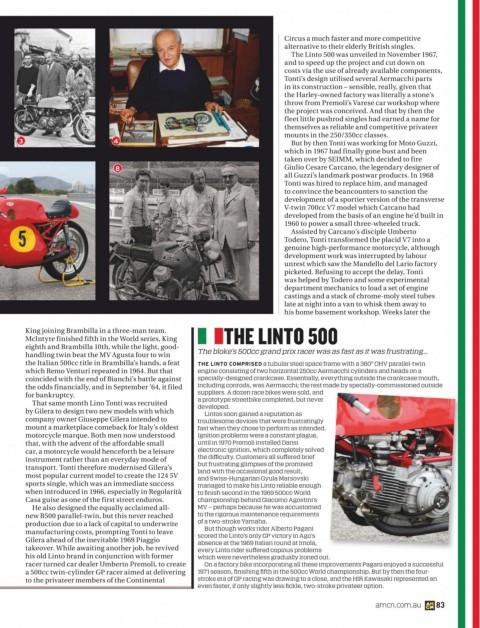
         the Italian 500cc title in Brambilla’s hands, a feat       THE LINTO COMPRISED a tubular steel space frame with a 360° OHV parallel-twin
         which Remo Venturi repeated in 1964. But that              engine consisting of two horizontal 250cc Aermacchi cylinders and heads on a
         coincided with the end of Bianchi’s battle against         specially-designed crankcase. Essentially, everything outside the crankcase mouth,
         the odds financially, and in September ’64, it filed       including conrods, was Aermacchi; the rest made by specially-commissioned outside
         for bankruptcy.                                            suppliers. A dozen race bikes were sold, and
            That same month Lino Tonti was recruited                a prototype streetbike completed, but never
                                                                    developed.
         by Gilera to design two new models with which                Lintos soon gained a reputation as
         company owner Giuseppe Gilera intended to                  troublesome devices that were frustratingly
         mount a marketplace comeback for Italy’s oldest            fast when they chose to perform as intended.
         motorcycle marque. Both men now understood                 Ignition problems were a constant plague,
         that, with the advent of the affordable small              until in 1970 Premoli installed Dansi
         car, a motorcycle would henceforth be a leisure            electronic ignition, which completely solved


         instrument rather than an everyday mode of                 the difficulty. Customers all suffered brief
                                                                    but frustrating glimpses of the promised
         transport. Tonti therefore modernised Gilera’s             land with the occasional good result,
         most popular current model to create the 124 5V            and Swiss-Hungarian Gyula Marsovski
         sports single, which was an immediate success              managed to make his Linto reliable enough
         when introduced in 1966, especially in Regolarità          to finish second in the 1969 500cc World

         Casa guise as one of the first street enduros.             championship behind Giacomo Agostini’s
            He also designed the equally acclaimed all-             MV – perhaps because he was accustomed
         new B500 parallel-twin, but this never reached             to the rigorous maintenance requirements
         production due to a lack of capital to underwrite          of a two-stroke Yamaha.
                                                                      But though works rider Alberto Pagani
         manufacturing costs, prompting Tonti to leave              scored the Linto’s only GP victory in Ago’s
         Gilera ahead of the inevitable 1969 Piaggio                absence at the 1969 Italian round at Imola,
         takeover. While awaiting another job, he revived           every Linto rider suffered copious problems

         his old Linto brand in conjunction with former             which were nevertheless gradually ironed out.
         racer turned car dealer Umberto Premoli, to create           On a factory bike incorporating all these improvements Pagani enjoyed a successful


         a 500cc twin-cylinder GP racer aimed at delivering         1971 season, finishing fifth in the 500cc World championship. But by then the four-
         to the privateer members of the Continental                stroke era of GP racing was drawing to a close, and the HIR Kawasaki represented an
                                                                    even faster, if only slightly less fickle, two-stroke privateer option.

                                                                                                                                amcn.com.au          83

