


Page 28 - All About History - Issue 72-18
P. 28
ROMAN EMPIRE


                  Historical Treasures


          VINDOLANDATABLETS


          ANCIENT WAYS OF LIFE PRESERVED IN THE MUD NORTHUMBERLAND, 85-130 CE


            t’s a miracle that we have these tablets at all     hospital. We also know what some of the soldiers         The first tablets were found at Vindolanda in
            considering how thin and fragile they are. Found    specialised in aside from war.                         1973 and since then, digs have been turning up
            during an excavation at the site of the Roman          Virilus and Ario were veterinarians,                           several of the ancient documents,
          Ifort of Vindolanda, today’s Northumberland, they     while Lucius’s trade was shield making                            allowing us to create a better picture
          were only preserved due to being buried in damp,      and Atrectus was a brewer. We are also                            of what life was really like in a Roman
          aerobic earth. Wafer thin, the small wooden slabs     told about the opposing Celtic warriors        “   ONE            fort. When they are uncovered, their
          are covered in a Latin scrawl detailing the daily     and how the Romans looked down on                                 preservation is of utmost importance
          lives of soldiers who spent their days at Hadrian’s   their weaponry and tactics.                 DETAILS A             so they are placed in water to clean
          Wall, the Roman Empire’s northernmost border.            Not everything in the tablets is all                           them, then immersed in baths of methyl
             The size of our postcards today, the Vindolanda    business, though – one details a birthday   BIRTHDAY              alcohol and ether to dry them out and
          tablets don’t look like much, but the details         party being thrown while another sees                             make them easier to read. While they
          they hold about ancient Roman daily life are a        a soldier asking his brother for money.      PARTY      ”         have been overtaken as the oldest
          rarity. One of the 1,600-odd tablets details work     We also know what people ate – over                               Roman writings found in Britain by
          assignments – out of 343 men, 12 were making          46 different foods are mentioned                                  some tablets that have been found in
          shoes, 18 were building the bath-house and the        throughout the tablets, including                                 London, they are still among the earliest
          rest were collecting rubble, plastering, assigned to   venison, honey, spices and olives. Even ordinary      texts produced in Roman Britain and hold a certain
          the wagons, tending to the kilns or working in the    soldiers could get hold of oysters and pepper.         amount of significance on that merit alone.


             It’s all Latin                                                                                                             Measuring up
             to me                                                                                                                      Onlythesizeofthepostcardswe
             The Romans would                                                                                                           use today, the Vindolanda tablets
             usually write on                                                                                                           and those found elsewhere in Britain
             wax tablets so that                                                                                                        don’tlooklikemuchwhenthey’re
             they could erase                                                                                                           dugup.They’realsoincredibly
             their writing when                                                                                                         flimsy at two to five millimetres
             they were done with                                                                                                        thick, and their age certainly doesn’t
             it. These tablets                                                                                                          help their fragile state.
             are written in ink,
             which has preserved
             incredibly well,
             meaningthatthese
             documentswereat
             one time considered
             to be important to
             the soldiers.
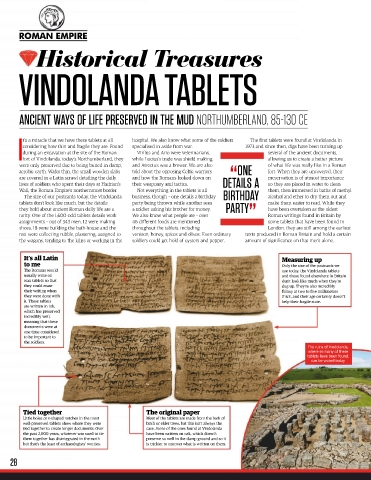
                                                                                                                                                     The ruins of Vindolanda,
                                                                                                                                                     where so many of these
                                                                                                                                                    tablets have been found,
                                                                                                                                                      can be visited today


            Tied together                                              The original paper

            Littleholesorv-shapednotchesinthemost                      Mostofthetabletsaremadefromthebarkof
            well-preserved tablets show where they were                birchoreldertrees,butthisisn’talwaysthe
            tied together to create longer documents. Over             case.SomeoftheonesfoundatVindolanda
            thepast2,000years,whateverwasusedtotie                     have been written on oak, which doesn’t
            them together has disintegrated in the earth               preserve so well in the damp ground and so it
            butthat’stheleastofarchaeologists’worries.                 is trickier to uncover what is written on them.


      28

