


Page 89 - All About History - Issue 72-18
P. 89
A WORLD WAR WITHOUT END?

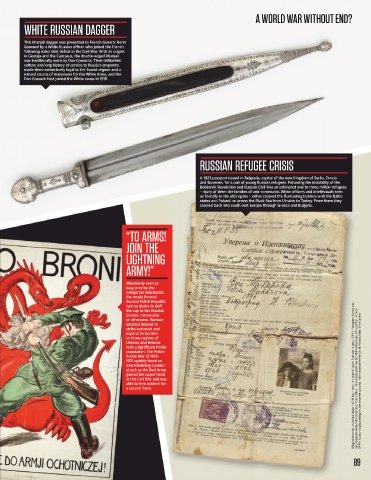
             WHITE RUSSIAN DAGGER


             This khanjali dagger was presented to French General Henri
             Gouraud by a White Russian officer who joined the French
             following nationalist defeat in the Civil War. With its origins
             in Georgia and the Caucasus, the double-edged khanjali
             was traditionally worn by Don Cossacks. Their militaristic
             culture and long history of service to Russia’s emperors
             made them instinctively loyal to the Tsarist regime and a
             natural source of manpower for the White Army, and the
             Don Cossack host joined the White cause in 1919.


                                                                                                 RUSSIAN REFUGEE CRISIS


                                                                                                 A 1923 passport issued in Belgrade, capital of the new Kingdom of Serbs, Croats
                                                                                                 andSlovenes,forapairofyoungRussianrefugees.Followingtheinstabilityofthe
                                                                                                 Bolshevik Revolution and Russian Civil War an estimated one to three million refugees
                                                                                                 – many of them the families of anti-communist White officers and intellectuals seen
                                                                                                 asfriendlytotheoldregime–eithercrossedthefluctuatingborderswiththeBaltic
                                                                                                 states and Poland, or across the Black Sea from Ukraine to Turkey. From there they
                                                                                                 crossedbackintosoutheastEuropethroughGreeceandBulgaria.


                                                              “TO ARMS!


                                                              JOIN THE

                                                              LIGHTNING


                                                              ARMY!”


                                                              Mistakenly seen as
                                                              easy prey by the
                                                              belligerent Bolsheviks,
                                                              the newly formed
                                                              Second Polish Republic
                                                              had no desire to doff
                                                              the cap to the Russian
                                                              Empire, communist
                                                              or otherwise. Warsaw
                                                              decided instead to
                                                              strike eastward and
                                                              expand its borders
                                                              to those regions of
                                                              Ukraine and Belarus
                                                              with a significant Polish
                                                              population. The Polish-
                                                              Soviet War of 1919-
                                                              1921 quickly faced an
                                                              overwhelming counter-
                                                              attack as the Red Army
                                                              gained the upper hand                                                                                        ©Riga, collection du Latvijas Kara Muzejs ; MoD Military History Institute and Museum, Budapest, Hungary ; ECPAD / Photograph: Marcel Lorée ;
                                                              in the Civil War and was                                                                                      Paris, Musée de l’Armée RMN-Grand Palais / Thierry Ollivier  ; Paris – Musée de l’Armée, Dist. RMN-Grand Palais / Émilie Cambier ; Archives  OFPRA ; Muzeum wojska polskiego (musée de l’armée polonaise)  ; Paris - Musée de l’Armée, Dist. RMN-Grand Palais / Émilie Cambier
                                                              able to free soldiers for
                                                              a second front.


                                                                                                                                                                           89

