


Page 185 - DK Eyewitness Travel Guides - The World's Must-See Places
P. 185
JORDAN 183
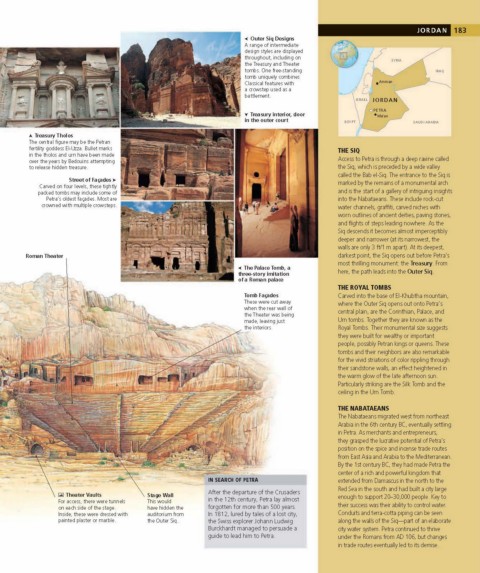
-c: Outer Siq Designs
A range of intermediate
design styles are displayed
throughout, including on
the Treasury and Theater
tombs. One free-standing
tomb uniquely combines
Classical features with
a crowstep used as a
battlement.
Y Treasury interior, door
in the outer court
A Treasury Tholos
The central figure may be the Petran
fertility goddess EI-Uzza. Bullet marks THE SIQ
in the th olos and urn have been made
over the years by Bedouins attempting Access to Petra is through a deep ravine called
to release hidden treasure. the Siq, which is preceded by a wide valley
called the Bab ei-Siq. The entrance to the Siq is
marked by the remains of a monumental arch
and is the start of a gallery of intriguing insights
into the Nabataeans. These include rock-cut
water channels, graffiti, carved niches with
worn outlines of ancient deities, paving stones,
and flights of steps I eadi ng nowhere. As the
Siq descends it becomes aim ost imperceptibly
deeper and narrower (at its narrowest, the
walls are only 3 tt/1 m apart). At its deepest,
Roman Theater darkest point, the Siq opens out before Petra's
most thrilling monument the Treasury, From
-c: The Palace Tomb, a
three-story imitation here, the path leads into the Outer Siq.
of a Roman palace
THE ROYAL TOMBS
Tomb Fa~des Carved into the base of EI-Khubtha mountain,
These were cut away where the Outer Siq opens out onto Petra's
when the rear wall of
the Theater was being central plain, are the Corinthian, Palace, and
made, leaving just Urn tombs. Together they are known as the
the interiors. Royal Tombs. Their monumental size suggests
they were built for wealthy or important
people, possibly Petran kings or queens. These
tombs and their neighbors are also remarkable
for the vivid striations of col or rippling through
their sandstone walls, an effect heightened in
the warm glow of the late afternoon sun.
Particularly striking are the Silk Tomb and the
ceiling in the Urn Tomb.
THE NABATAEANS
The Nabataeans migrated west from northeast
Arabia in the 6th century BC, eventually settling
in Petra. As merchants and entrepreneurs,
they grasped the lucrative potential of Petra's
position on the spice and incense trade routes
from East A~ a and Arabia to the Mediterranean.
By the 1st century BC, they had made Petra the
center of a rich and powerful kingdom that
IN SEARCH OF PETRA extended from Dam ascus in the north to the
Red Sea in the south and had built a city large
After the departure of the Crusaders
SlageWall enough to support 20-30,000 people. Key to
For access, there were tunnels This would in the 1 2th century, Petra lay almost
on each side of the stage. have hidden the forgotten for more than 500 years. their success was their ability to control water.
Inside, these were dressed with auditorium from In 181 2, lured by tales of a I ost city, Conduits and terra-cotta piping can be seen
painted plaster or marble. the Outer Siq the Swiss explorer Johann Ludwig along the walls of the Siq-part of an elaborate
Burckhardt managed to persuade a city water system. Petra continued to thrive
guide to lead him to Petra. under the Romans from .AD 1 06, but changes
in trade routes eventually led to its demise.

