


Page 8 - DK Eyewitness Travel Guides - The World's Must-See Places
P. 8
6  INTRODUCTION

                               Introduction


                               Ancient Greek and Roman  travelers, whose idea of enjoyment
                               was probably little different from our own, had few sights
                                to visit. It was therefore not difficult for Greek writers to list
                                 the seven  best and call them the "wonders of the world."
                                  Civilizations have come a long way since then, the world
                                  has shrunk with high-speed travel,  and there has  been  no
                                       let-up in  the desire to build. These days,  it would be
                                         hard to pin point the seven  most wondrous buildings
                                          in  the world,  but here are 103 sights that should
                                          not be missed.

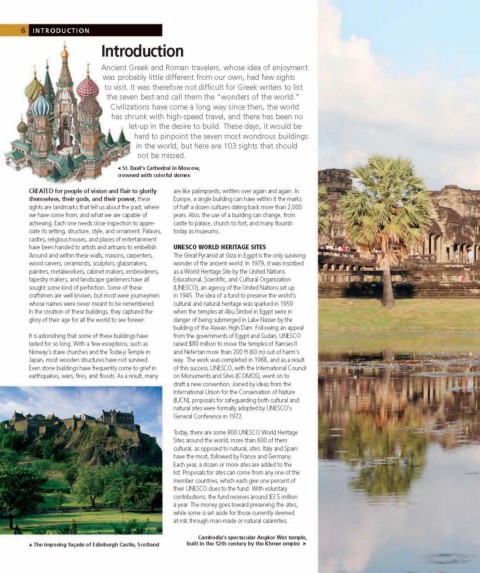
                                    <St. Basil's Cathedral in Moscow,
                                    crowned with colorful domes

          CREATED for people of vision and flair to glorify   are like palimpsests, written over again a nd again. In
          themselves, their gods, and their power, these   Europe, a  single building can have within it the marks
          sights are  I  andm arks  that tell us  about the past, where   of half a  dozen cultures  dating back more than 2,000
         we have come from, and what we are capable of   years. Also, the use of a building can change, from
          achieving. Each one needs close inspection to appre-  castle to palace, church to fort, and many flouris h
          ciate its  setting, structure, style, and ornament. Palaces,   today as museums.
          castles, religious houses, and places of entertainment
          ha ve been handed to artists and artisans to embellish.   UNESCO WORLD  HERITAGE SITES
         Around and within these walls, masons, carpenters,   The Great Pyramid at Giza in Egypt is the only surviving
         wood carvers, ceramidsts, sruptors, glassmakers,   wonder of the andent world.  In 1979, it  was inscribed
          painters, metalworkers, cabinet makers, embroiderers,   as a  World Heritage Site by the l.klited Nations
          tapestJy makers, and landscape gardeners have all   Education~,  Sdentific, and Cultl.f~ Orgarization
          sougot some kind of  perfection. Some of these   QJI\ESC  0), an agency of the United Nations set up
          craftsmen are well known, but most were journeymen   in 1945. The idea of a  fund to preserve the world's
          whose names were never meant to be remembered.   cultural and natural heritage was sparked in 1959
          In the creation of these buildings, they captured the   when the temples at Abu Simbel in Egypt were in
          glory of their age for all the world to see forever.   danger of being submerged in Lake Nasser by the
                                                     building of the Aswan High Dam.  Following an appeal
          It is astonishing that some of these buildings have   from the governments of Egypt and S udan, UNESCO
          lasted for so long. With a few exceptions , s uch as   raised $80 million to move  the temples of Ramses II
          Norway's stave  churches and the T odai-ji Temple in   and Nefertari more than 200 ft (60 m) out of harm's
          Japan, most wooden structures ha ve  not s urvived.   way. The work was completed in 1968, and as a  result
          Even stone buildings ha ve  frequently come to grief in   of this success, UN  ESC 0, with the  International Council
          earthquakes, wars , fires, and floods. As a  result, many   on Monuments and Sites Q C  OMO$), went on to
                                                     draft a new convention. J oined by ideas from the
                                                     lnternati onal Union for the  Conservation of Nature
                                                     QUCN), proposals for safeguarding both cultural and
                                                     natural sites were formally adopted by UNESCO's
                                                     General Conference in 1972.

                                                     Toda y, there are some 800 UI\ESC 0 World Heritage
                                                     Sites aound the world, more than 600 of them
                                                     cultural, as opposed to natural, sites.  Italy and Spain
                                                     have the most, followed by France and Germany.
                                                     Each year, a  dozen or more sites are added to the
                                                     list.  Proposals for sites can come from any one of  the
                                                     member countries, which each give one percent of
                                                     their U\IE SCO dues to the fund. With voluntary
                                                     contributions, the fund receives  around $3.5  million
                                                     a  year. The money goes toward preserving the s ites,
                                                     while some is set aside for those currently deemed
                                                     at risk through man-made  or natural calamities.

                                                            Cambodia's specmwlar Angl<or Wat temple,
         A The imposing fa~ade  of Edinburgh Castle, Scotland   built in the 12th century by the Khmer empire >-

