


Page 96 - DK Eyewitness Travel Guides - The World's Must-See Places
P. 96
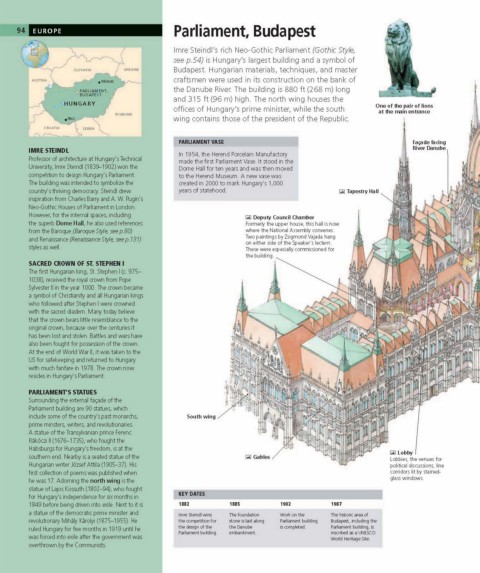
Parliament, Budapest
      94  EUROPE


                                                     lmre Steindl's rich  Neo-Gothic Parliament (Gothic Style,
                                                     see p.54)  is Hungary's largest building and a s ymbol of
                                                     Budapest.  Hungarian materials, techniques, and master
                                                     craftsmen were used  in its construction on the bank of
                                                     the Danube River.  The building is 880ft (268m) long
                                                     and 315 ft (96 m) high.  The north wing houses the
                                                                                                                 One of the pair  of lions
                                                     offices of Hungary's prime minister, while the south         at the main entrance
                                                     wing contains those of the president of the R epublic.


                                                      PARLIAMENT VASE                                                       Fa~a de  facing
         IMRE STEINDL                                                                                                       River Danube
                                                      In  19 54, the Herend P orcelain Manufactory
         Professor o f architecture  at Hungary's  T echnical
                                                      made the first Parliament Vase. It stood in the
         Univers ity, lmre  S teindl (1839-1902)  won the   Dome Hall for ten years  and  was then moved
         competition to design H ungary's  Parliament   to the H  erend Museum. A ne w vase was
         The building  was  intended  to symbolize the   created in 2000 to mark Hungary's 1,000
         country's thriving democracy. S teindl dre w   years of statehood.                           ~ Tapestry  Hall
         inspiration from C harles Barry and A. W. Pugin's
         Neo-Gothic Houses of P arliament in L ondon.
          However, for the  interna l s paces, including
                                                                          ~  Deputy Council Chamber
         the superb Dome  Hall, he  also used re ferences                 F ormerly the upper house,  this  hall is now
         from the  Baroque  (Barcque Style, see p.80)                     where the National Assembly convenes.
                                                                          Two paintings by Zsigmond Vajada hang
         and Renaissance (Renaissance Style, see p.131)
                                                                          on either side of the Speaker's lectern.
         s tyles as  -well.                                               These were especially cormissioned for
                                                                          the building.
          SACRED CROWN OF ST. STEPHEN I
          The first Hungarian long, St  Stephen I  (c  97S-
          1  038), received the royal cro'M"I from Pope
          Sylvester ll1n the ye<r 1000  The crown became
          a symbol of Chnsban1ty and all Hung<rian kings
         who followed after Stephen I -were cro'M"Ied
         with the sacred diadem.  Maf'¥ today believe
         that the crown bears  little  resemblance to the
         original crown, because over the  centuries it
         has been I  os t and stolen.  Battles and wars have
         also been  fought for possession of the crown.
         At the end of World  War II, it was taken to  the
         US for s afekeeping and re turne d to Hungary
         with much fanfare  in 1978. T he  crown now
         resides  in Hungary's  P arliament.

         PARLIAMENT'S STATUES
         S urrounding the  external fa~ade of the
         P arliament building are 90 statues, which
         include some of the  country's past monarchs,   South wing
         prime  minsters, writers, and revolutionaries.
         A statue of the Transylvanian pnnce Ferenc
          Rakoczi II (1676-1735), who fought the
          Habsburgs for Hungary's freedom, is at the
                                                                                                                     ~ L obby
         southern end  Nearby is a  seated statue of the                  ~ Gab les                                  Lobbies, the venues for
         Hungarian wrrter Jozsef Atbla (1905-37). His                                                                political discussions. line
         first cdlectioo of poems was pt.bhshed W'len                                                                corridors lit by stained-
                                                                                                                     glass wind<ms.
          he was 17  Adom1ng the north wing is the
          statue of LaJOs Kossuth (1802-94), who fought
                                                      KEY DATES
         for Hungary's independence for six months  in
          1849 before be1ng driven into ex1le. Next to it is   1882   1885           1902           1987
         a sta tue of the  democratic  prime  m1  nister and   lmre Steindl wins   The foundation   w ork on the   The historic area of
         revolutionary Mih~ly ~rolyi (1875-1955). H e   the competition  for   stone is laid along   Parliament building   Budapest, including the
         ruled Hungary for five  months  in 1919 until he   the design of the   the Danube   Is completed.   Parliament building, is
                                                      Parliament building.   embankment.            inscribed as a UNESCO
         was forced into exile  after the  government was
                                                                                                    World Heritage Site.
         overthrown by  the  Communists.

