


Page 118 - (DK Eyewitness) Travel Guide - Australia
P. 118
116 SY DNEY
Exploring the
Art Gallery’s Collection
The gallery’s early focus was on Australian and British art, and
these areas continue to be well represented. Aboriginal art
began to be added to the collection during the 1940s, with
strong acquisition programmes in recent decades. The
Contemporary galleries are an exciting addition, with both
international and Australian pieces on display. The gallery stages
major temporary exhibitions, and the annual Archibald, Wynne
and Sulman prizes always entertain and usually stir controversy.
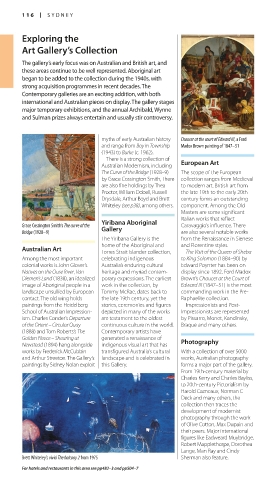
myths of early Australian history Chaucer at the court of Edward III, a Ford haucer at the court of Edward III, a Ford haucer at the court of Edward III
C C
and range from Boy in Township Madox Brown painting of 1847–51
(1943) to Burke (c. 1962). Burke (c. 1962). Burke
There is a strong collection of
Australian Modernism, including European Art
T T The Curve of the Bridge (1928–9) he Curve of the Bridge (1928–9) he Curve of the Bridge The scope of the European
by Grace Cossington Smith, There collection ranges from Medieval
are also fine holdings by Thea to modern art. British art from
Proctor, William Dobell, Russell the late 19th to the early 20th
Drysdale, Arthur Boyd and Brett century forms an outstanding
Whiteley (see p38), among others. component. Among the Old
Masters are some significant
Italian works that reflect
Yiribana Aboriginal
Grace Cossington Smith’s The curve of the Caravaggio’s influence. There
Bridge (1928–9) Gallery are also several notable works
The Yiribana Gallery is the from the Renaissance in Sienese
home of the Aboriginal and and Florentine styles.
Australian Art Torres Strait Islander collection, The Visit of the Queen of Sheba
Among the most important celebrating indigenous to King Solomon (1884–90) by
colonial works is John Glover’s Australia’s enduring cultural Edward Poynter has been on
Nativ heritage and myriad contem- display since 1892. Ford Madox
Nativ
Natives on the Ouse River, es on the Ouse River, es on the Ouse River Van
Diemen’s Land (1838), an idealized iemen’s Land (1838), an idealized iemen’s Land
D D porary expressions. The earliest Brown’s Chaucer at the Court of
image of Aboriginal people in a work in the collection, by E E Edward III (1847–51) is the most dward III (1847–51) is the most dward III
landscape unsullied by European Tommy McRae, dates back to commanding work in the Pre-
contact. The old wing holds the late 19th century, yet the Raphaelite collection.
paintings from the Heidelberg stories, ceremonies and figures Impressionists and Post-
School of Australian Impression- depicted in many of the works Impressionists are represented
ism. Charles Conder’s Departure are testament to the oldest by Pissarro, Monet, Kandinsky,
of the Orient – Circular Quay continuous culture in the world. Braque and many others.
(1888) and Tom Roberts’s The Contemporary artists have
Golden Fleece – Shearing at generated a renaissance of Photography
Newstead (1894) hang alongside wstead (1894) hang alongside wstead
Ne
Ne indigenous visual art that has
works by Frederick McCubbin transfigured Australia’s cultural With a collection of over 5000
and Arthur Streeton. The Gallery’s landscape and is celebrated in works, Australian photography
paintings by Sidney Nolan exploit this Gallery. forms a major part of the gallery.
From 19th-century material by
Charles Kerry and Charles Bayliss,
to 20th-century Pictorialism by
Harold Cazneaux, Norman C
Deck and many others, the
collection then traces the
development of modernist
photography through the work
of Olive Cotton, Max Dupain and
their peers. Major international
figures like Eadweard Muybridge,
Robert Mapplethorpe, Dorothea
Lange, Man Ray and Cindy
Brett Whiteley’s vivid The balcony 2 from 1975 Sherman also feature.
For hotels and restaurants in this area see pp482–3 and pp504–7

