


Page 128 - (DK Eyewitness) Travel Guide - Australia
P. 128
126 SY DNEY
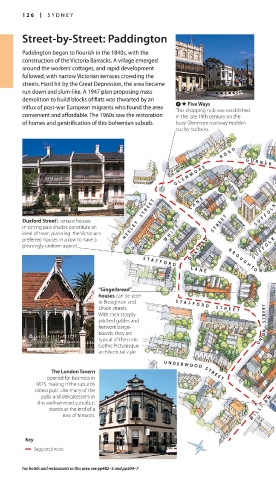
Street-by-Street: Paddington
Paddington began to flourish in the 1840s, with the
construction of the Victoria Barracks. A village emerged
around the workers’ cottages, and rapid development
followed, with narrow Victorian terraces crowding the
streets. Hard hit by the Great Depression, the area became
run down and slum-like. A 1947 plan proposing mass
demolition to build blocks of flats was thwarted by an
influx of post-war European migrants who found the area 8. Five Ways
This shopping hub was established
convenient and affordable. The 1960s saw the restoration in the late 19th century on the
of homes and gentrification of this bohemian suburb. busy Glenmore roadway trodden
out by bullocks.
R O A D
G U R N E R
G L E N M O R E
S T R E E T L A N E
Duxford Street’s terrace houses S T R E E T S U F F O L K
in toning pale shades constitute an H E E L E Y
ideal of town planning: the Victorians W H I T E
preferred houses in a row to have a
D U X F O R D B R O U G H T S U F F O L K
pleasingly uniform aspect.
S T A F F O R D
O N
L A N E
“
“Gingerbread” Gingerbread”
houses can be seen
in Broughton and S T A F F O R D
Union streets. S T R E E T
With their steeply S T R E E T
pitched gables and
fretwork barge
boards, they are
typical of the rustic U N I O N
Gothic Picturesque
architectural style.
The London Tavern U N D E R W O O D S T R E E T
opened for business in
1875, making it the suburb’s
oldest pub. Like many of the
pubs and delicatessens in
this wellserviced suburb, it A M
stands at the end of a
row of terraces. W I L L I
Key
Suggested route
For hotels and restaurants in this area see pp482–3 and pp504–7

