


Page 166 - (DK Eyewitness) Travel Guide - Australia
P. 166
164 NE W SOUTH W ALES AND A C T
The Snowy Mountains
The Snowy Mountains stretch 500 km (310 miles) from
Canberra to Victoria. Formed more than 250 million years
ago, they include Australia’s highest mountain, Mount
Kosciuszko, and the country’s only glacial lakes. In summer,
wildflowers carpet the meadows; in winter, snow gums bend
beneath the cold winds. The Snowy Mountains are preserved The Snowy Mountains are home to
within the Kosciuszko National Park and are also home to two the Kosciuszko National Park which
of Australia’s largest ski resorts, Thredbo and Perisher. The was declared a World Biosphere
Snowy Mountains Scheme dammed four rivers to supply Reserve by UNESCO in 1997.
power to much of inland eastern Australia (see p187).
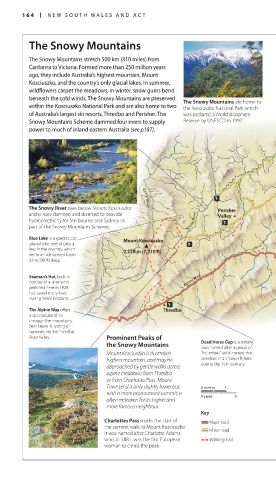
The Snowy River rises below Mount Kosciuszko Geehi River Perisher
and is now damned and diverted to provide Valley
hydroelectricity for Melbourne and Sydney as Snowy River w wy
part of the Snowy Mountains Scheme.
Blue Lake is a spectacular Mount Kosciuszko
glacial lake, one of only a
few in the country, which 2,228 m (7,310 ft)
lies in an ice-carved basin
28 m (90 ft) deep.
Seaman’s Hut, built in
honour of a skier who Alpine Way
perished here in 1928,
has saved many lives
during fierce blizzards.
The Alpine Way offers Thredbo
a spectacular drive
through the mountains,
best taken in spring or
summer, via the Thredbo
River Valley. Prominent Peaks of
the Snowy Mountains Dead Horse Gap is a striking
pass named after a group of
Mount Kosciuszko is Australia’s “brumbies” (wild horses) that
highest mountain, and may be perished in a snowdrift here
during the 19th century.
approached by gentle walks across
alpine meadows from Thredbo
or from Charlottes Pass. Mount
Townsend is only slightly lower but, 0 metres 5
with a more pronounced summit, is 0 yards 5
often mistaken for its higher and
more famous neighbour.
Key
Charlottes Pass marks the start of Major road
the summit walk to Mount Kosciuszko. Minor road
It was named after Charlotte Adams,
who, in 1881, was the first European Walking trail
woman to climb the peak.

