


Page 343 - (DK Eyewitness) Travel Guide - Australia
P. 343
INTRODUCING SOUTH A USTR ALIA 341
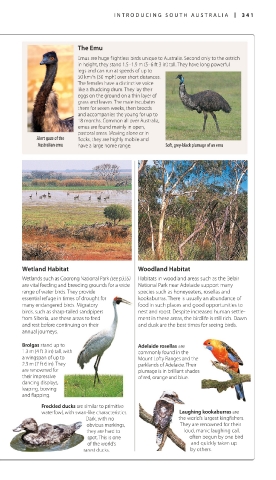
The Emu
Emus are huge flightless birds unique to Australia. Second only to the ostrich
in height, they stand 1.5–1.9 m (5–6 ft 3 in) tall. They have long powerful
legs and can run at speeds of up to
50 km/h (30 mph) over short distances.
The females have a distinctive voice
like a thudding drum. They lay their
eggs on the ground on a thin layer of
grass and leaves. The male incubates
them for seven weeks, then broods
and accompanies the young for up to
18 months. Common all over Australia,
emus are found mainly in open,
pastoral areas. Moving alone or in
Alert gaze of the flocks, they are highly mobile and
Australian emu have a large home range. Soft, grey-black plumage of an emu
Wetland Habitat Woodland Habitat
Wetlands such as Coorong National Park (see p355) Habitats in woodland areas such as the Belair
are vital feeding and breeding grounds for a wide National Park near Adelaide support many
range of water birds. They provide species such as honeyeaters, rosellas and
essential refuge in times of drought for kookaburras. There is usually an abundance of
many endangered birds. Migratory food in such places and good opportunities to
birds, such as sharp-tailed sandpipers nest and roost. Despite increased human settle-
from Siberia, use these areas to feed ment in these areas, the birdlife is still rich. Dawn
and rest before continuing on their and dusk are the best times for seeing birds.
annual journeys.
Brolgas stand up to Adelaide rosellas are
1.3 m (4 ft 3 in) tall, with commonly found in the
a wingspan of up to Mount Lofty Ranges and the
2.3 m (7 ft 6 in). They parklands of Adelaide. Their
are renowned for plumage is in brilliant shades
their impressive of red, orange and blue.
dancing displays,
leaping, bowing
and flapping.
Freckled ducks are similar to primitive
waterfowl, with swan-like characteristics. Laughing kookaburras are
Dark, with no the world’s largest kingfishers.
obvious markings, They are renowned for their
they are hard to loud, manic laughing call,
spot. This is one often begun by one bird
of the world’s and quickly taken up
rarest ducks. by others.

