


Page 410 - (DK Eyewitness) Travel Guide - Australia
P. 410
408 VIC T ORIA
. Rippon Lea
Rippon Lea Mansion, designed by Joseph Reed
and built in 1868, is now part of the National
Trust’s portfolio. The house is a much loved
fixture of the city’s heritage. The first family of
Rippon Lea were the Sargoods, who held many
balls and parties during the 1880s and 1890s.
The next owner, Premier Sir Thomas Bent,
sold off parts of the estate in the early 1900s.
The Nathans bought Rippon Lea in 1910 and
restored its reputation as a family home.
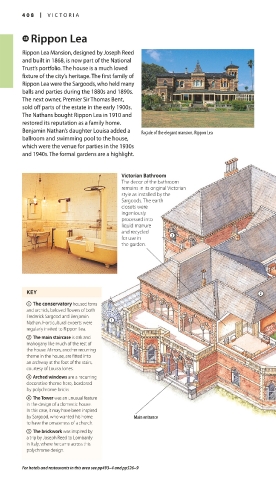
Benjamin Nathan’s daughter Louisa added a Façade of the elegant mansion, Rippon Lea
ballroom and swimming pool to the house,
which were the venue for parties in the 1930s
and 1940s. The formal gardens are a highlight.
Victorian Bathroom
The decor of the bathroom
remains in its original Victorian
style as installed by the
Sargoods. The earth
closets were
ingeniously
processed into
liquid manure
and recycled
for use in
the garden.
KEY
1 The conservatory housed ferns The conservatory housed ferns The conservatory
and orchids, beloved flowers of both
Frederick Sargood and Benjamin
Nathan. Horticultural experts were
regularly invited to Rippon Lea.
2 The main staircase is oak and
mahogany like much of the rest of
the house. Mirrors, another recurring
theme in the house, are fitted into
an archway at the foot of the stairs,
courtesy of Louisa Jones.
3 Arched windows are a recurring
decorative theme here, bordered
by polychrome bricks.
4 The Tower was an unusual feature
in the design of a domestic house.
In this case, it may have been inspired
by Sargood, who wanted his home Main entrance
to have the ornateness of a church.
5 The brickwork was inspired by The brickwork was inspired by The brickwork
a trip by Joseph Reed to Lombardy
in Italy, where he came across this
polychrome design.
For hotels and restaurants in this area see pp493–4 and pp526–9

