


Page 553 - (DK Eyewitness) Travel Guide - Australia
P. 553
PR A C TIC AL INFORM A TION 551
Local Currency
circulation, so the total amount avoid any misunderstandings.
The Australian currency is the to be paid will be rounded up Otherwise, when you arrive at
Australian dollar (A$), which or down to the nearest 5c. your destination, you may have
breaks down into 100 cents (c). It can be hard to change A$50 to find change at the nearest
The decimal currency system and A$100 notes, so avoid using shop or ATM or pay with a credit
now in place has been in them for low-cost goods in small card, which incurs extra fees.
operation since 1966. shops and cafés and when To improve security, as well
Single cents may still be used paying for taxi fares. If you do not as to increase their lifespan,
for some prices, but Australian have change, tell the taxi driver all Australian bank notes
1c and 2c coins are no longer in before you start your journey to are plasticized.
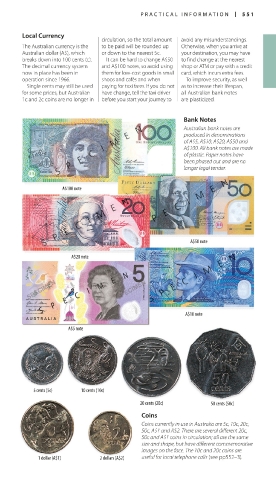
Bank Notes
Australian bank notes are
produced in denominations
of A$5, A$10, A$20, A$50 and
A$100. All bank notes are made
of plastic. Paper notes have
been phased out and are no
longer legal tender.
A$100 note
A$50 note
A$20 note
A$10 note
A$5 note
5 cents (5c) 10 cents (10c)
20 cents (20c) 50 cents (50c)
Coins
Coins currently in use in Australia are 5c, 10c, 20c,
50c, A$1 and A$2. There are several different 20c,
50c and A$1 coins in circulation; all are the same
size and shape, but have different commemorative
images on the face. The 10c and 20c coins are
1 dollar (A$1) 2 dollars (A$2) useful for local telephone calls (see pp552–3).

