


Page 121 - The Rough Guide to Myanmar (Burma)
P. 121
Sittwe The DelTa anD wesTern MyanMar  119
                                          Bhaddanta Wannita Museum (750m) & Jetty (1.5km)
           SITTWE

         EATING                 NGA PAIN STREET
        501 Tea & Cold Garden  4
        May Yu     2
        Mya Tea House  3                KIN G  M IN B A R  GY I  ST RE ET  SHWE THA STREET
        River Valley  1                      NGA PAIN STREET
                             Shwezadi   U OTTAMA         STREET
        Sakrokeya River                               NGA PAIN STREET STRAND ROAD  2
                             Monastery
           MERCHANT S TREET                       M A I N   R O A D  U OTTAMA STREET
                                          Shwe Pyi Tan  THA ZAN HAL STREET
                                          (boat tickets)
                                                   KBZ Bank  Rice Market
                                 M ER C HAN T  S TR EET Mayflower Air
          N                             Ticket Centre  HTEE DAN STREET
                                               Old
                                           Clocktower  MERCHANT STREET
                                    YE DWIN STREET
                                               Cultural SHWE THA              STREET
                                                 ZE GYI STREET
                                               Museum    Market
      Lawkananda Pagoda (250m), Airport (2km) & Bus Station (4km)  K ING  M I N BA R  G YI   ST RE ET  University  U Ottama   STRAND ROAD  Kaladan
                                              Mosque
                                        Park
                                                           River
             KYAUNG GYI ROAD
                      City
                                     M A I N   R O A D  Kiss Guesthouse  1
                      Hall            KYAUNG GYI ROAD   Port
                                                       ACCOMMODATION
                               Clocktower             Mya Guesthouse  5 2
                                                      Noble Hotel
        0      200  Police                 SHUKHIN THA   S TREET  Royal Sittwe Resort  6 4
                                                      Shwe Thazin
           metres                                     Strand Hotel  3
                                     (2.5km)  View Point (3km)
       has been cut off from mainstream Burmese life, and the town immediately feels less
       developed and somehow a little different to many others in Myanmar.
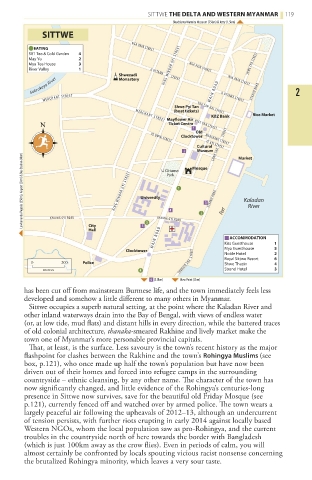
        Sittwe occupies a superb natural setting, at the point where the Kaladan River and
       other inland waterways drain into the Bay of Bengal, with views of endless water
       (or, at low tide, mud flats) and distant hills in every direction, while the battered traces
       of old colonial architecture, thanaka-smeared Rakhine and lively market make the
       town one of Myanmar’s more personable provincial capitals.
        That, at least, is the surface. Less savoury is the town’s recent history as the major
       flashpoint for clashes between the Rakhine and the town’s Rohingya Muslims (see
       box, p.121), who once made up half the town’s population but have now been
       driven out of their homes and forced into refugee camps in the surrounding
       countryside – ethnic cleansing, by any other name. The character of the town has
       now significantly changed, and little evidence of the Rohingya’s centuries-long
       presence in Sittwe now survives, save for the beautiful old Friday Mosque (see
       p.121), currently fenced off and watched over by armed police. The town wears a
       largely peaceful air following the upheavals of 2012–13, although an undercurrent
       of tension persists, with further riots erupting in early 2014 against locally based
       Western NGOs, whom the local population saw as pro-Rohingya, and the current
       troubles in the countryside north of here towards the border with Bangladesh
       (which is just 100km away as the crow flies). Even in periods of calm, you will
       almost certainly be confronted by locals spouting vicious racist nonsense concerning
       the brutalized Rohingya minority, which leaves a very sour taste.


   098-137_Myanmar_B2_Ch2.indd   119                           30/06/17   2:20 pm

