


Page 50 - (DK) Help Your Kids with Growing Up: A No-Nonsense Guide to Puberty and Adolescence
P. 50
48        MALE  PUBERT Y


        Male hormones                                                      SEE ALSO
                                                                           ‹
                                                                            46–47  What is puberty?
                                                                           Changing body          50–51  ›
        Hormones are chemicals, produced in the body, which send           Testicles              52–53  ›
        instructions to cells. Each hormone can only affect specific target   Breaking voices     56–57  ›
        cells, which contain the appropriate receptor for that hormone.

        Kickstarting puberty
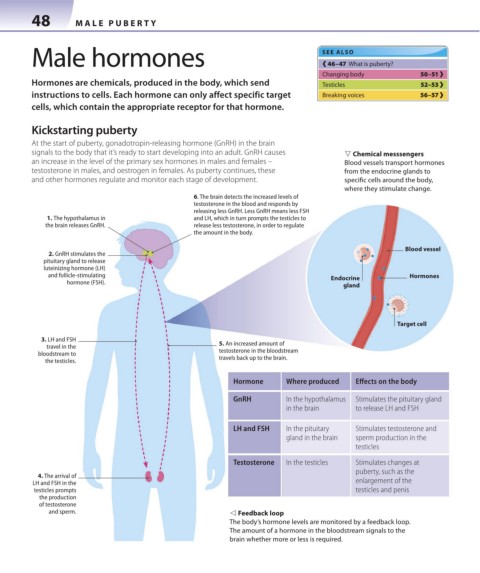
        At the start of puberty, gonadotropin-releasing hormone (GnRH) in the brain
        signals to the body that it’s ready to start developing into an adult. GnRH causes   ▽ Chemical messsengers
        an increase in the level of the primary sex hormones in males and females –   Blood vessels transport hormones
        testosterone in males, and oestrogen in females. As puberty continues, these    from the endocrine glands to
        and other hormones regulate and monitor each stage of development.      specific cells around the body,
                                                                                where they stimulate change.
                                              6. The brain detects the increased levels of
                                              testosterone in the blood and responds by
                                              releasing less GnRH. Less GnRH means less FSH
            1. The hypothalamus in            and LH, which in turn prompts the testicles to
           the brain releases GnRH.           release less testosterone, in order to regulate
                                              the amount in the body.
                                                                                              Blood vessel
            2. GnRH stimulates the
           pituitary gland to release
           luteinizing hormone (LH)
            and follicle-stimulating                                         Endocrine         Hormones
                hormone (FSH).                                                  gland


                                                                                             Target cell
          3. LH and FSH                            5. An increased amount of
            travel in the
          bloodstream to                           testosterone in the bloodstream
           the testicles.                          travels back up to the brain.
                                                       Hormone     Where produced  Effects on the body

                                                       GnRH        In the hypothalamus   Stimulates the pituitary gland
                                                                   in the brain    to release LH and FSH

                                                       LH and FSH  In the pituitary   Stimulates testosterone and
                                                                   gland in the brain  sperm production in the
                                                                                   testicles
                                                       Testosterone  In the testicles  Stimulates changes at
                                                                                   puberty, such as the
          4. The arrival of
        LH and FSH in the                                                          enlargement of the
         testicles prompts                                                         testicles and penis
          the production
          of testosterone
            and sperm.                                ◁ Feedback loop
                                                      The body’s hormone levels are monitored by a feedback loop.
                                                      The amount of a hormone in the bloodstream signals to the
                                                      brain whether more or less is required.


   048-049_Male_hormones.indd   48                                                                   24/03/2017   17:15

