


Page 58 - (DK) Help Your Kids with Growing Up: A No-Nonsense Guide to Puberty and Adolescence
P. 58
56        MALE  PUBERT Y


        Breaking voices                                                    SEE ALSO
                                                                           ‹
                                                                           ‹ 46–47  What is puberty?
                                                                            48–49  Male hormones
        During puberty, the voices of both males and females change to     ‹ 50–51  Changing body
        a lower pitch than that of pre-puberty. The deepening in females’   Confidence and self-esteem   86–87  ›
        voices is hardly noticeable, but some males’ voices drop dramatically.
        When this happens, people say a male’s voice is “breaking”.


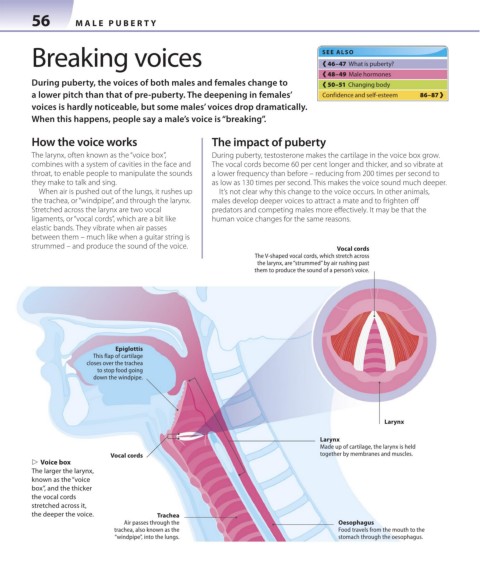
        How the voice works                       The impact of puberty
        The larynx, often known as the “voice box”,   During puberty, testosterone makes the cartilage in the voice box grow.
        combines with a system of cavities in the face and   The vocal cords become 60 per cent longer and thicker, and so vibrate at
        throat, to enable people to manipulate the sounds   a lower frequency than before – reducing from 200 times per second to
        they make to talk and sing.               as low as 130 times per second. This makes the voice sound much deeper.
          When air is pushed out of the lungs, it rushes up   It’s not clear why this change to the voice occurs. In other animals,
        the trachea, or “windpipe”, and through the larynx.   males develop deeper voices to attract a mate and to frighten off
        Stretched across the larynx are two vocal   predators and competing males more effectively. It may be that the
        ligaments, or “vocal cords”, which are a bit like   human voice changes for the same reasons.
        elastic bands. They vibrate when air passes
        between them – much like when a guitar string is
        strummed – and produce the sound of the voice.                         Vocal cords
                                                            The V-shaped vocal cords, which stretch across
                                                            the larynx, are “strummed” by air rushing past
                                                            them to produce the sound of a person’s voice.


                            Epiglottis
                      This flap of cartilage
                     closes over the trachea
                       to stop food going
                      down the windpipe.


                                                                                          Larynx

                                                                           Larynx
                                                                           Made up of cartilage, the larynx is held
                          Vocal cords                                      together by membranes and muscles.
        ▷ Voice box
        The larger the larynx,
        known as the “voice
        box”, and the thicker
        the vocal cords
        stretched across it,
        the deeper the voice.        Trachea
                              Air passes through the                           Oesophagus
                           trachea, also known as the                          Food travels from the mouth to the
                           “windpipe”, into the lungs.                         stomach through the oesophagus.


   056-057_Breaking_voices.indd   56                                                                 24/03/2017   17:15

