


Page 129 - Atlas Of The World's Strangest Animals
P. 129
EMPEROR TAMARIN              129


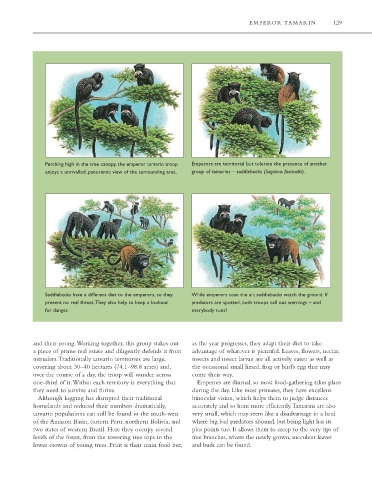
                 Perching high in the tree canopy, the emperor tamarin troop  Emperors are territorial but tolerate the presence of another
                 enjoys a unrivalled, panoramic view of the surrounding area.  group of tamarins – saddlebacks (Saguinus fuscicollis).


                 Saddlebacks have a different diet to the emperors, so they  While emperors scan the air, saddlebacks watch the ground. If
                 present no real threat.They also help to keep a lookout   predators are spotted, both troops call out warnings – and
                 for danger.                                       everybody runs!


             and their young.Working together, this group stakes out  as the year progresses, they adapt their diet to take
             a piece of prime real estate and diligently defends it from  advantage of whatever is plentiful. Leaves, flowers, nectar,
             intruders.Traditionally tamarin territories are large,  insects and insect larvae are all actively eaten as well as
             covering about 30–40 hectares (74.1–98.8 acres) and,   the occasional small lizard, frog or bird’s egg that may
             over the course of a day, the troop will wander across  come their way.
             one-third of it.Within each territory is everything that  Emperors are diurnal, so most food-gathering takes place
             they need to survive and thrive.                       during the day. Like most primates, they have excellent
              Although logging has disrupted their traditional      binocular vision, which helps them to judge distances
             homelands and reduced their numbers dramatically,      accurately and so hunt more efficiently.Tamarins are also
             tamarin populations can still be found in the south-west  very small, which may seem like a disadvantage in a land
             of the Amazon Basin, eastern Peru, northern Bolivia, and  where big bad predators abound, but being light has its
             two states of western Brazil. Here they occupy several  plus points too. It allows them to creep to the very tips of
             levels of the forest, from the towering tree tops to the  tree branches, where the newly grown, succulent leaves
             lower crowns of young trees. Fruit is their main food but,  and buds can be found.


                                             (c) 2011 Marshall Cavendish. All Rights Reserved.

