


Page 121 - (DK Eyewitness) Travel Guide - Greek Islands
P. 121
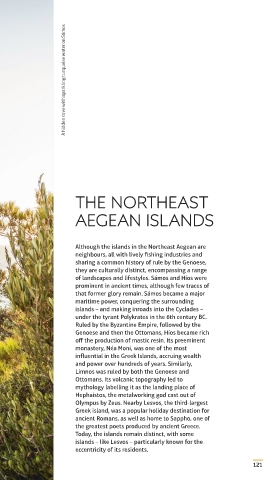
A hidden cove with sparkling turquoise water on Sámos


                    THE NORTHEAST

                    AEGEAN ISLANDS


                    Although the islands in the Northeast Aegean are
                    neighbours, all with lively fishing industries and
                    sharing a common history of rule by the Genoese,
                    they are culturally distinct, encompassing a range
                    of landscapes and lifestyles. Sámos and Híos were
                    prominent in ancient times, although few traces of
                    that former glory remain. Sámos became a major
                    maritime power, conquering the surrounding
                    islands – and making inroads into the Cyclades –
                    under the tyrant Polykrates in the 6th century BC.
                    Ruled by the Byzantine Empire, followed by the
                    Genoese and then the Ottomans, Híos became rich
                    off the production of mastic resin. Its preeminent
                    monastery, Néa Moní, was one of the most
                    influential in the Greek Islands, accruing wealth
                    and power over hundreds of years. Similarly,
                    Límnos was ruled by both the Genoese and
                    Ottomans. Its volcanic topography led to
                    mythology labelling it as the landing place of
                    Hephaistos, the metalworking god cast out of
                    Olympus by Zeus. Nearby Lesvos, the third-largest
                    Greek island, was a popular holiday destination for
                    ancient Romans, as well as home to Sappho, one of
                    the greatest poets produced by ancient Greece.
                    Today, the islands remain distinct, with some
                    islands – like Lesvos – particularly known for the
                    eccentricity of its residents.
                                                                  121


   120-121_EW_Greek_Islands.indd   121                       27/11/2018   17:20

