


Page 201 - (DK Eyewitness) Travel Guide - Greek Islands
P. 201
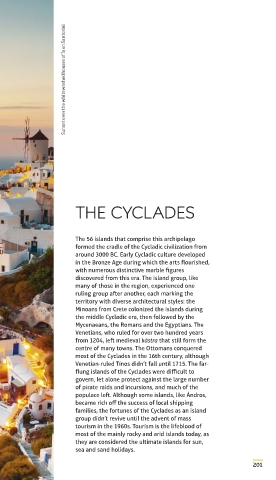
Sunset over the whitewashed houses of Ía on Santoríni


                    THE CYCLADES


                    The 56 islands that comprise this archipelago
                    formed the cradle of the Cycladic civilization from
                    around 3000 BC. Early Cycladic culture developed
                    in the Bronze Age during which the arts flourished,
                    with numerous distinctive marble figures
                    discovered from this era. The island group, like
                    many of those in the region, experienced one
                    ruling group after another, each marking the
                    territory with diverse architectural styles: the
                    Minoans from Crete colonized the islands during
                    the middle Cycladic era, then followed by the
                    Mycenaeans, the Romans and the Egyptians. The
                    Venetians, who ruled for over two hundred years
                    from 1204, left medieval kástra that still form the
                    centre of many towns. The Ottomans conquered
                    most of the Cyclades in the 16th century, although
                    Venetian-ruled Tínos didn’t fall until 1715. The far-
                    flung islands of the Cyclades were difficult to
                    govern, let alone protect against the large number
                    of pirate raids and incursions, and much of the
                    populace left. Although some islands, like Ándros,
                    became rich off the success of local shipping
                    families, the fortunes of the Cyclades as an island
                    group didn’t revive until the advent of mass
                    tourism in the 1960s. Tourism is the lifeblood of
                    most of the mainly rocky and arid islands today, as
                    they are considered the ultimate islands for sun,
                    sea and sand holidays.
                                                                  201


   200-201_EW_Greek_Islands.indd   201                       27/11/2018   17:20

