


Page 49 - (DK Eyewitness) Travel Guide - Greek Islands
P. 49
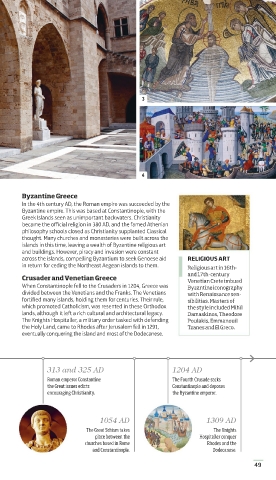
3


                                     4

       Byzantine Greece
       In the 4th century AD, the Roman empire was succeeded by the
       Byzantine empire. This was based at Constantinople, with the
       Greek Islands seen as unimportant backwaters. Christianity
       became the official reli gion in 380 AD, and the famed Athenian
       philo so phy schools closed as Christianity supplanted Classical
       thought. Many churches and monasteries were built across the
       islands in this time, leaving a wealth of Byzantine religious art
       and buildings. However, piracy and invasion were constant
       across the islands, com pel ling Byzantium to seek Genoese aid   RELIGIOUS ART
       in return for ceding the Northeast Aegean islands to them.   Religious art in 16th-
                                                 and 17th-century
       Crusader and Venetian Greece              Venetian Crete imbued
       When Constantinople fell to the Crusaders in 1204, Greece was   Byzantine iconography
       divided between the Venetians and the Franks. The Venetians   with Renaissance sen-
       fortified many islands, holding them for centuries. Their rule,   sibilities. Masters of
       which promoted Catholicism, was resented in these Orthodox   the style included Mihïl
       lands, although it left a rich cultural and architectural legacy.   Damaskinos, Theodore
       The Knights Hospitaller, a military order tasked with defending   Poulakis, Emmanouil
       the Holy Land, came to Rhodes after Jerusalem fell in 1291,   Tzanes and El Greco.
       eventually conquering the island and most of the Dodecanese.


             313 and 325 AD                  1204 AD
             Roman emperor Constantine       The Fourth Crusade sacks
             the Great issues edicts         Constantinople and deposes
             encouraging Christianity.       the Byzantine emperor.


                           1054 AD                    1309 AD
                       The Great Schism takes           The Knights
                         place between the          Hospitaller conquer
                       churches based in Rome         Rhodes and the
                         and Constantinople.            Dodecanese.
                                                                  49


   046-051_EW_Greek_Islands.indd   49                        28/11/2018   12:38

