


Page 65 - All About History - Issue 18-14
P. 65
My Way: Frank Sina a  Dark


                                                              Frank Sinatra signing a contract to
                                                           perform regularly in Las Vegas played
                                                            a big part in building the city’s status


                         Sinatra talking with reporters
                      during his trial for battery against
                             journalist Lee Mortimer


                                               Hoboken Four (they were a trio until Dolly leaned
                                               on them to let Frank join). This led to years of
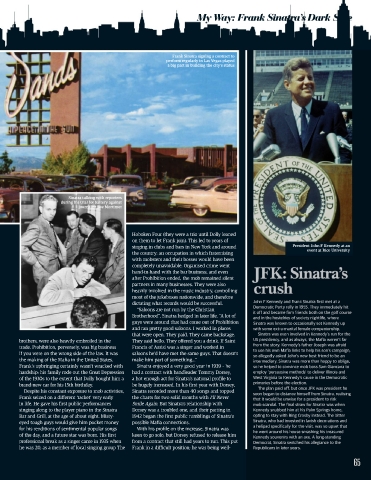
                                               singing in clubs and bars in New York and around         President John F Kennedy at an
                                                                                                             event at Rice University
                                               the country: an occupation in which fraternising
                                               with mobsters and their bosses would have been
                                               completely unavoidable. Organised crime went
                                               hand-in-hand with the bar business, and even
                                               after Prohibition ended, the mob remained silent
                                               partners in many businesses. They were also
                                               heavily involved in the music industry, controlling
                                               most of the jukeboxes nationwide, and therefore
                                               dictating what records would be successful.
                                                 “Saloons are not run by the Christian
                                               Brotherhood”, Sinatra hedged in later life. “A lot of
                                               guys were around that had come out of Prohibition
                                               and ran pretty good saloons. I worked in places
                                               that were open. They paid. They came backstage.
        brothers, were also heavily embroiled in the   They said hello. They offered you a drink. If Saint
        trade. Prohibition, perversely, was big business   Francis of Assisi was a singer and worked in
        if you were on the wrong side of the law. It was   saloons he’d have met the same guys. That doesn’t
        the making of the Mafia in the United States.   make him part of something…”
        Frank’s upbringing certainly wasn’t wracked with   Sinatra enjoyed a very good year in 1939 – he
        hardship: his family rode out the Great Depression   had a contract with bandleader Tommy Dorsey,
        of the 1930s to the extent that Dolly bought him a   a hot enough act for Sinatra’s national profile to
        brand-new car for his 15th birthday.   be hugely increased. In his first year with Dorsey,
          Despite his constant exposure to mob activities,   Sinatra recorded more than 40 songs and topped
        Frank seized on a different ‘racket’ very early   the charts for two solid months with I’ll Never
        in life. He gave his first public performances   Smile Again. But Sinatra’s relationship with
        singing along to the player piano in the Sinatra   Dorsey was a troubled one, and their parting in
        Bar and Grill, at the age of about eight. Misty-  1942 began the first public rumblings of Sinatra’s
        eyed tough guys would give him pocket money   possible Mafia connections.
        for his renditions of sentimental popular songs   With his profile on the increase, Sinatra was
        of the day, and a future star was born. His first   keen to go solo, but Dorsey refused to release him
        professional break as a singer came in 1935 when   from a contract that still had years to run. This put
        he was 20, as a member of local singing group The   Frank in a difficult position; he was being well-

