


Page 84 - All About History - Issue 18-14
P. 84
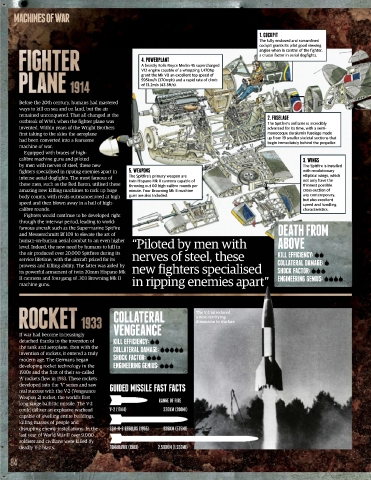
1. COCKPIT
                                                                                            The fully enclosed and streamlined
                                                                                            cockpit grants its pilot good viewing
                                                                                            angles when in control of the fighter,
                                                                                            a crucial factor in aerial dogfights.
                                                   4. POWERPLANT
                                                   AbeastlyRolls-RoyceMerlin45supercharged
                                                   V12 engine capable of a whopping 1,470hp
                                                   grant the Mk VB an excellent top speed of
                                                   595km/h(370mph)andarapidrateofclimb
                                                   of 13.2m/s (43.3ft/s).


        Beforethe20thcentury,humanshadmastered
        ways to kill on sea and on land, but the air
        remained unconquered. That all changed at the                                          2. FUSELAGE
        outbreak of WWI, when the fighter plane was
                                                                                               The Spitfire’s airframe is incredibly
        invented. Within years of the Wright Brothers                                          advancedforitstime,withasemi-
        firsttakingtotheskiestheaeroplane                                                      monocoqueduraluminfuselagemade
                                                                                               upfrom19smallerskeletalsectionsthat
        hadbeenconvertedintoafearsome
                                                                                               begin immediately behind the propeller.
        machine of war.
         Equipped with braces of high-
        calibremachinegunsandpiloted                                                                        3. WINGS
        bymenwithnervesofsteel,thesenew                                                                     The Spitfire is installed
        fighters specialised in ripping enemies apart in  5. WEAPONS                                        with revolutionary
        intenseaerialdogfights.Themostfamousof  The Spitfire’s primary weapon are                           elliptical wings, which
                                              twin Hispano Mk II cannons capable of
                                                                                                            notonlyhavethe
        these men, such as the Red Baron, utilised these  throwing out 60 high-calibre rounds per           thinnest possible
        amazingnewkillingmachinestorackuphuge  minute. Four Browning Mk II machine                          cross-section of
        bodycounts,withrivalsoutmanoeuvredathigh  gunsarealsoincluded.                                      any contemporary,
                                                                                                            butalsoexcellent
        speedandthenblownawayinahailofhigh-                                                                 speed and handling
        calibre rounds.                                                                                     characteristics.
         Fighterswouldcontinuetobedevelopedright
        through the interwar period, leading to world-
        famous aircraft such as the Supermarine Spitfire                                           DEATHFROM
        andMesserschmittBf109toelevatetheartof
        human-on-human aerial combat to an even higher  “Piloted by men with                       ABOVE
        level.Indeed,thenewneedbyhumanstokillin
        the air produced over 20,000 Spitfires during its  nerves of steel, these                  KILL EFFICIENCY:
        service lifetime, with the aircraft prized for its                                         COLLATERAL DAMAGE:
        prowess and killing ability. The latter was aided by  newfightersspecialised
        itspowerfularmamentoftwin20mmHispanoMk                                                     SHOCK FACTOR:
        IIcannonsandfour-gangof.303BrowningMkII  in ripping enemies apart”                         ENGINEERING GENIUS:
        machine guns.


                                         COLLATERAL                   The V-2 introduced
                                                                      a new, terrifying
                                                                      dimensiontowarfare
                                         VENGEANCE
        If war had become increasingly
        detached thanks to the invention of  KILL EFFICIENCY:
        the tank and aeroplane, then with the  COLLATERAL DAMAGE:
        inventionofrockets,itenteredatruly
        modern age. The Germans began    SHOCK FACTOR:
        developing rocket technology in the  ENGINEERING GENIUS:
        1930sandthefirstoftheirso-called
        ‘A’ rockets flew in 1933. These rockets
        developedintothe‘V’seriesandsaw  GUIDED MISSILE FAST FACTS
        real success with the V-2 (Vengeance
        Weapon2)rocket,theworld’sfirst                   RANGE OF FIRE
        long-range ballistic missile. The V-2
        could deliver an explosive warhead  V-2 (1944)    320KM (200MI)
        capable of levelling entire buildings,
        killingmassesofpeopleand
        disrupting enemy installations. In the  SSM-N-8 REGULUS (1955)  926KM (575MI)
        last year of World War II over 9,000
        soldiers and civilians were killed by
        deadly V-2 blasts.              TOMAHAWK (1983)  2,500KM (1,550MI)

