


Page 648 - The Book of Caterpillars: A Life-Size Guide to Six Hundred Species From Around the World
P. 648
CLASSIFICATION


          of the LEPIDOPTERA


          When the Swedish naturalist Carl Linnaeus first classified   ORDER LEPIDOPTERA
          Lepidoptera in his Systema Naturae (1758), he divided them
          into just three genera. His genus Papilio included all known   Unassigned early lepidopterans
          butterflies, while large hovering hawkmoths were placed in   Family Archaeolepidae [1]
          the genus Sphinx, and the rest of the moths in the genus   Family Mesokristenseniidae [3]
          Phalaena, which Linnaeus divided into seven subgroups.  Family Eolepidopterigidae [1]
                                                    Family Undopterigidae [1]
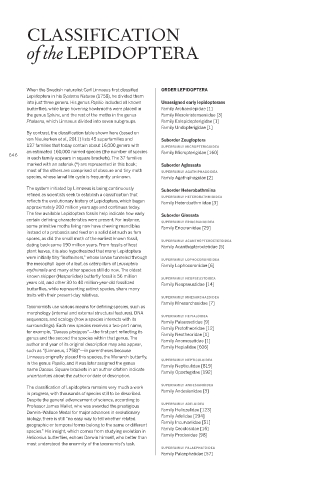
          By contrast, the classification table shown here (based on
          van Nieukerken et al., 2011) lists 45 superfamilies and    Suborder Zeugloptera
          137 families that today contain about 16,000 genera with    superfamily micropterigoidea
          an estimated 160,000 named species (the number of species    Family Micropterigidae [160]
    646
          in each family appears in square brackets). The 37 families
          marked with an asterisk (*) are represented in this book;    Suborder Aglossata
          most of the others are comprised of obscure and tiny moth   superfamily agathiphagoidea
          species, whose larval life cycle is frequently unknown.   Family Agathiphagidae [2]
          The system initiated by Linnaeus is being continuously   Suborder Heterobathmiina
          refined as scientists seek to establish a classification that   superfamily heterobathmioidea
          reflects the evolutionary history of Lepidoptera, which began   Family Heterobathmiidae [3]
          approximately 200 million years ago and continues today.
          The few available Lepidoptera fossils help indicate how early   Suborder Glossata
          certain defining characteristics were present. For instance,   superfamily eriocranioidea
          some primitive moths living now have chewing mandibles   Family Eriocraniidae [29]
          instead of a proboscis and feed on a solid diet such as fern
          spores, as did the small moth of the earliest known fossil,   superfamily acanthopteroctetoidea
          dating back some 190 million years. From fossils of host   Family Acanthopteroctetidae [5]
          plant leaves, it is also hypothesized that many Lepidoptera
          were initially tiny “leafminers,” whose larvae tunneled through   superfamily lophocoronoidea
          the mesophyll layer of a leaf, as caterpillars of Leucoptera   Family Lophocoronidae [6]
          erythrinella and many other species still do now. The oldest
          known skipper (Hesperiidae) butterfly fossil is 56 million   superfamily neopseustoidea
          years old, and other 30 to 40 million-year-old fossilized   Family Neopseustidae [14]
          butterflies, while representing extinct species, share many
          traits with their present-day relatives.   superfamily mnesarchaeoidea
                                                    Family Mnesarchaeidae [7]
          Taxonomists use various means for defining species, such as
          morphology (internal and external structural features), DNA   superfamily hepialoidea
          sequences, and ecology (how a species interacts with its   Family Palaeosetidae [9]
          surroundings). Each new species receives a two-part name,   Family Prototheoridae [12]
          for example, “Danaus plexippus”—the first part reflecting its   Family Neotheoridae [1]
          genus and the second the species within that genus. The   Family Anomosetidae [1]
          author and year of its original description may also appear,   Family Hepialidae [606]
          such as “(Linnaeus, 1758)”—in parentheses because
          Linnaeus originally placed this species, the Monarch butterfly,   superfamily nepticuloidea
          in the genus Papilio, and it was later assigned the genus    Family Nepticulidae [819]
          name Danaus. Square brackets in an author citation indicate   Family Opostegidae [192]
          uncertainties about the author or date of description.
                                                    superfamily andesianoidea
          The classification of Lepidoptera remains very much a work
          in progress, with thousands of species still to be described.   Family Andesianidae [3]
          Despite the general advancement of science, according to
          Professor James Mallet, who was awarded the prestigious   superfamily adeloidea
          Darwin–Wallace Medal for major advances in evolutionary   Family Heliozelidae [123]
          biology, there is still “no easy way to tell whether related   Family Adelidae [294]
          geographic or temporal forms belong to the same or different   Family Incurvariidae [51]
          species.” His insight, which comes from studying evolution in   Family Cecidosidae [16]
          Heliconius butterflies, echoes Darwin himself, who better than   Family Prodoxidae [98]
          most understood the enormity of the taxonomist’s task.
                                                    superfamily palaephatoidea
                                                    Family Palaephatidae [57]

