


Page 111 - Guitar Classics Magazine - The Les Paul Bible 2019
P. 111
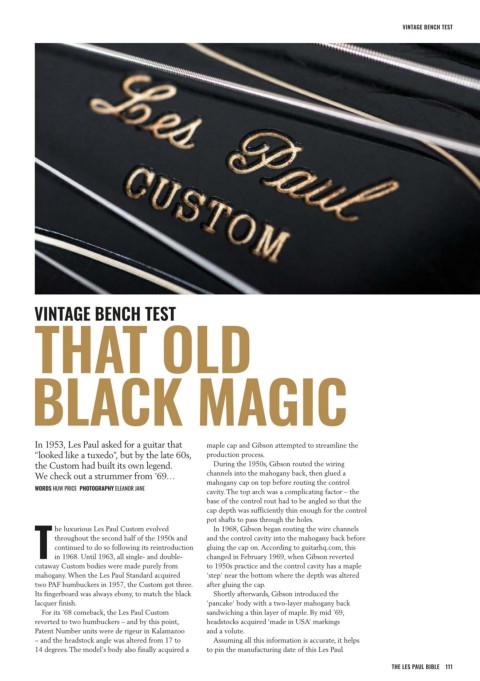
VINTAGE BENCH TEST


         VINTAGE BENCH TEST

         THAT OLD


         BLACK MAGIC


          In 1953, Les Paul asked for a guitar that   maple cap and Gibson attempted to streamline the
          “looked like a tuxedo”, but by the late 60s,   production process.
          the Custom had built its own legend.        During the 1950s, Gibson routed the wiring
          We check out a strummer from ’69…         channels into the mahogany back, then glued a
                                                    mahogany cap on top before routing the control
          WORDS HUW PRICE  PHOTOGRAPHY ELEANOR JANE
                                                    cavity. The top arch was a complicating factor – the
                                                    base of the control rout had to be angled so that the
                                                    cap depth was sufficiently thin enough for the control
                                                    pot shafts to pass through the holes.
              he luxurious Les Paul Custom evolved    In 1968, Gibson began routing the wire channels
              throughout the second half of the 1950s and   and the control cavity into the mahogany back before
              continued to do so following its reintroduction   gluing the cap on. According to guitarhq.com, this
         T in 1968. Until 1963, all single- and double-  changed in February 1969, when Gibson reverted
          cutaway Custom bodies were made purely from   to 1950s practice and the control cavity has a maple
          mahogany. When the Les Paul Standard acquired    ‘step’ near the bottom where the depth was altered
          two PAF humbuckers in 1957, the Custom got three.   after gluing the cap.
          Its fingerboard was always ebony, to match the black   Shortly afterwards, Gibson introduced the
          lacquer finish.                           ‘pancake’ body with a two-layer mahogany back
           For its ’68 comeback, the Les Paul Custom   sandwiching a thin layer of maple. By mid ’69,
          reverted to two humbuckers – and by this point,   headstocks acquired ‘made in USA’ markings
          Patent Number units were de rigeur in Kalamazoo   and a volute.
          – and the headstock angle was altered from 17 to   Assuming all this information is accurate, it helps
          14 degrees. The model’s body also finally acquired a   to pin the manufacturing date of this Les Paul

                                                                                                  THE LES PAUL BIBLE  111

