


Page 117 - Guitar Classics Magazine - The Les Paul Bible 2019
P. 117
VINTAGE BENCH TEST


          since 1969. Much of the gold plating has rubbed
          off the hardware or picked up verdigris around the
          edges, the clear coats over the binding have yellowed
          considerably and by the same process, the pearl inlays
          on the peghead have acquired a golden hue.
           Look closely and you’ll see how the Gibson logo
          evolved from the ‘kissing dot’ style of 1952 to the
          missing dot of 1969 as it migrated northwards away
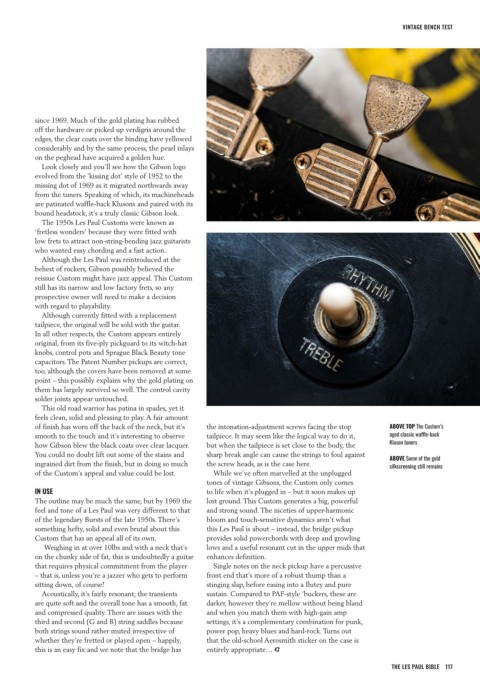
          from the tuners. Speaking of which, its machineheads
          are patinated waffle-back Klusons and paired with its
          bound headstock, it’s a truly classic Gibson look.
           The 1950s Les Paul Customs were known as
          ‘fretless wonders’ because they were fitted with
          low frets to attract non-string-bending jazz guitarists
          who wanted easy chording and a fast action.
           Although the Les Paul was reintroduced at the
          behest of rockers, Gibson possibly believed the
          reissue Custom might have jazz appeal. This Custom
          still has its narrow and low factory frets, so any
          prospective owner will need to make a decision
          with regard to playability.
           Although currently fitted with a replacement
          tailpiece, the original will be sold with the guitar.
          In all other respects, the Custom appears entirely
          original, from its five-ply pickguard to its witch-hat
          knobs, control pots and Sprague Black Beauty tone
          capacitors. The Patent Number pickups are correct,
          too, although the covers have been removed at some
          point – this possibly explains why the gold plating on
          them has largely survived so well. The control cavity
          solder joints appear untouched.
           This old road warrior has patina in spades, yet it
          feels clean, solid and pleasing to play. A fair amount
          of finish has worn off the back of the neck, but it’s   the intonation-adjustment screws facing the stop   ABOVE TOP The Custom’s
          smooth to the touch and it’s interesting to observe   tailpiece. It may seem like the logical way to do it,   aged classic wale-back
          how Gibson blew the black coats over clear lacquer.   but when the tailpiece is set close to the body, the   Kluson tuners
          You could no doubt lift out some of the stains and   sharp break angle can cause the strings to foul against
                                                                                                 ABOVE Some of the gold
          ingrained dirt from the finish, but in doing so much   the screw heads, as is the case here.  silkscreening still remains
          of the Custom’s appeal and value could be lost.   While we’ve often marvelled at the unplugged
                                                    tones of vintage Gibsons, the Custom only comes
          IN USE                                    to life when it’s plugged in – but it soon makes up
          The outline may be much the same, but by 1969 the   lost ground. This Custom generates a big, powerful
          feel and tone of a Les Paul was very different to that   and strong sound. The niceties of upper-harmonic
          of the legendary Bursts of the late 1950s. There’s   bloom and touch-sensitive dynamics aren’t what
          something hefty, solid and even brutal about this   this Les Paul is about – instead, the bridge pickup
          Custom that has an appeal all of its own.   provides solid powerchords with deep and growling
            Weighing in at over 10lbs and with a neck that’s   lows and a useful resonant cut in the upper mids that
          on the chunky side of fat, this is undoubtedly a guitar   enhances definition.
          that requires physical commitment from the player   Single notes on the neck pickup have a percussive
          – that is, unless you’re a jazzer who gets to perform   front end that’s more of a robust thump than a
          sitting down, of course!                  stinging slap, before easing into a flutey and pure
           Acoustically, it’s fairly resonant; the transients   sustain. Compared to PAF-style ’buckers, these are
          are quite soft and the overall tone has a smooth, fat   darker, however they’re mellow without being bland
          and compressed quality. There are issues with the   and when you match them with high-gain amp
          third and second (G and B) string saddles because   settings, it’s a complementary combination for punk,
          both strings sound rather muted irrespective of   power pop, heavy blues and hard-rock. Turns out
          whether they’re fretted or played open – happily,   that the old-school Aerosmith sticker on the case is
          this is an easy fix and we note that the bridge has   entirely appropriate…

                                                                                                  THE LES PAUL BIBLE  117

