


Page 77 - Guitar Classics Magazine - The Les Paul Bible 2019
P. 77
VINTAGE BENCH TEST


          and defined, with powerchords having a piano-like
          richness. Note-to-note separation is truly exceptional,
          yet the transient attack has a slight softness that could
          be attributable to the weaker early 50s magnets and
          there’s never even a hint of harshness.
           Maybe it’s due to the wider pickup spacing, but
          the tonal contrast between the two pickups is
          marked. The bridge does a sweet kerrang and roar,
          but it also has a wiry twang on the low strings and a
          subtle bite in the treble. There is a hint of cocked wah
          in the upper mids from both pickups and although
          there is some quackiness, it provides character
          without being too prominent.
           The neck pickup is far smoother and jazzier than
          the bridge. Single notes have a full and rounded
          quality that translates to a distinctly vocal ‘ooh’ as
          you play further up the neck. The almost uncanny
          cleanup capability is there with both pickups from
          10 to one, and the control pots have a smooth and
          noise-free response – with the exception of the
          slightly scratchy neck tone.
           The in-between position produces a sublime
          rockabilly-meets-Chet type of tone with the sort of
          hi-fi clarity that compares to a DeArmond-loaded
          Gretsch. Roll back the bridge volume a tad and
          with a hint of overdrive, the tone takes on a horn-like
          quality that would be superb for jump-blues soloing
          and brassy stabs.                            IF WE WERE TO CHOOSE THREE
           The action is perhaps a tad higher than it could
          be, but it’s such an easy guitar to play you soon stop   WORDS TO DESCRIBE THIS GUITAR’S
          noticing. It’s a mystery why anybody considered it
          necessary to change the tuners, because even with   TONE, WE’D GO WITH ‘CLEAR’,
          vigorous Bigsby activity, the tuning remains stable.
           Had 1952 Les Pauls been fitted with a different   ‘VERSATILE’ AND ‘BIG’. FRESH TONES
          bridge, the neck angle would have worked and had
          it been used with a steeper neck angle, the tailpiece   AND TEXTURES KEEP EMERGING
          would have been fine.
           Since it’s such a tough job to re-set a Les Paul
          neck, it makes sense to change the bridge and
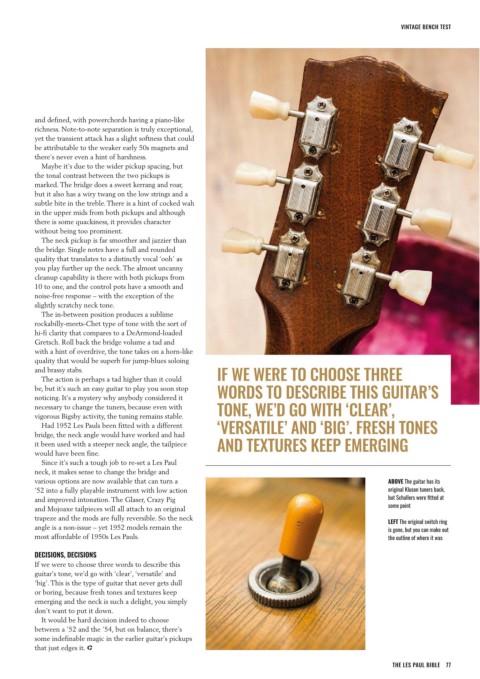
          various options are now available that can turn a                                      ABOVE The guitar has its
          ’52 into a fully playable instrument with low action                                   original Kluson tuners back,
          and improved intonation. The Glaser, Crazy Pig                                         but Schallers were itted at
          and Mojoaxe tailpieces will all attach to an original                                  some point
          trapeze and the mods are fully reversible. So the neck
                                                                                                 LEFT The original switch ring
          angle is a non-issue – yet 1952 models remain the                                      is gone, but you can make out
          most affordable of 1950s Les Pauls.                                                    the outline of where it was

          DECISIONS, DECISIONS
          If we were to choose three words to describe this
          guitar’s tone, we’d go with ‘clear’, ‘versatile’ and
          ‘big’. This is the type of guitar that never gets dull
          or boring, because fresh tones and textures keep
          emerging and the neck is such a delight, you simply
          don’t want to put it down.
           It would be hard decision indeed to choose
          between a ’52 and the ’54, but on balance, there’s
          some indefinable magic in the earlier guitar’s pickups
          that just edges it.

                                                                                                   THE LES PAUL BIBLE  77

