


Page 95 - Guitar Classics Magazine - The Les Paul Bible 2019
P. 95
VINTAGE BENCH TEST


          VINTAGE BENCH TEST

          CUSTOM FIT


          The black-lacquered, jazz-club
          sophistication of the earliest LP
          Custom takes more of its styling
          cues from Steinway than Stromberg.
          We step out with a grand ’56 model…
          WORDS HUW PRICE  PHOTOGRAPHY ELEANOR JANE


            ntroduced in late 1953, the first Les Paul Custom
            differs from the standard Goldtop model in three
            ways – an all-mahogany body, a fully intonatable
         I bridge and a ‘staple’ single-coil pickup in the neck
          position. The latter seems to have been an attempt
          to keep the man whose name was on the headstock
          on-brand – early photos of Les Paul using his
          signature model reveal that he’d installed a
          DeArmond Dynasonic in the neck position of his
          Goldtop, and Gibson was not pleased.
           Les Paul was such a superstar, the fact that he felt
          the need to mod his new signature solidbody with an
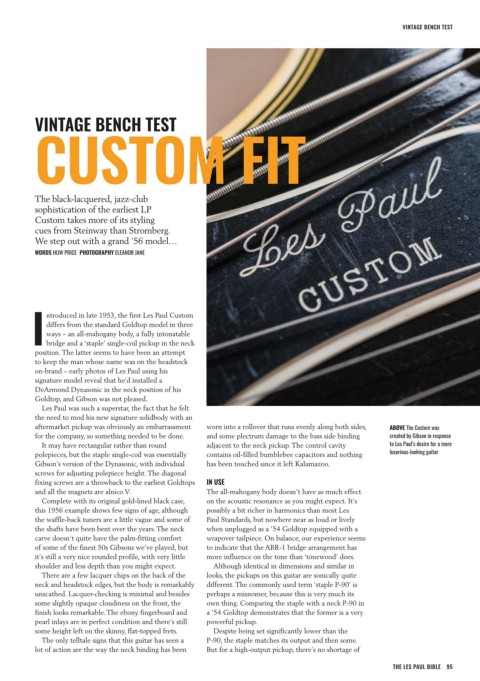
          aftermarket pickup was obviously an embarrassment   worn into a rollover that runs evenly along both sides,   ABOVE The Custom was
          for the company, so something needed to be done.  and some plectrum damage to the bass side binding   created by Gibson in response
           It may have rectangular rather than round   adjacent to the neck pickup. The control cavity   to Les Paul’s desire for a more
          polepieces, but the staple single-coil was essentially   contains oil-filled bumblebee capacitors and nothing   luxurious-looking guitar
          Gibson’s version of the Dynasonic, with individual   has been touched since it left Kalamazoo.
          screws for adjusting polepiece height. The diagonal
          fixing screws are a throwback to the earliest Goldtops   IN USE
          and all the magnets are alnico V.         The all-mahogany body doesn’t have as much effect
           Complete with its original gold-lined black case,   on the acoustic resonance as you might expect. It’s
          this 1956 example shows few signs of age, although   possibly a bit richer in harmonics than most Les
          the waffle-back tuners are a little vague and some of   Paul Standards, but nowhere near as loud or lively
          the shafts have been bent over the years. The neck   when unplugged as a ’54 Goldtop equipped with a
          carve doesn’t quite have the palm-fitting comfort   wrapover tailpiece. On balance, our experience seems
          of some of the finest 50s Gibsons we’ve played, but   to indicate that the ABR-1 bridge arrangement has
          it’s still a very nice rounded profile, with very little   more influence on the tone than ‘tonewood’ does.
          shoulder and less depth than you might expect.  Although identical in dimensions and similar in
           There are a few lacquer chips on the back of the   looks, the pickups on this guitar are sonically quite
          neck and headstock edges, but the body is remarkably   different. The commonly used term ‘staple P-90’ is
          unscathed. Lacquer-checking is minimal and besides   perhaps a misnomer, because this is very much its
          some slightly opaque cloudiness on the front, the   own thing. Comparing the staple with a neck P-90 in
          finish looks remarkable. The ebony fingerboard and   a ’54 Goldtop demonstrates that the former is a very
          pearl inlays are in perfect condition and there’s still   powerful pickup.
          some height left on the skinny, flat-topped frets.   Despite being set significantly lower than the
           The only telltale signs that this guitar has seen a   P-90, the staple matches its output and then some.
          lot of action are the way the neck binding has been   But for a high-output pickup, there’s no shortage of

                                                                                                  THE LES PAUL BIBLE  95

