


Page 102 - (DK Eyewitness) Travel Guide - New York City
P. 102
100 NE W Y ORK CIT Y AREA B Y AREA
It is small wonder, then, that it stores housed within to see
cost over $1 million to build – the spacious interior lofts. At the
and with profits of over $50,000 corner of Greene and Prince
for that year it must have streets, the illusionistic muralist
seemed money well spent. Its Richard Haas has created an
glory was short-lived, however. eye-catching work, disguising
In the Civil War it served as a a plain brick sidewall as a cast-
Union Army head quarters. iron frontage. Look for the detail
Afterward, the better hotels of the little gray cat, which sits
followed the entertain ment primly in an “open window.”
district uptown, and by the
mid-1870s the St. Nicholas 4 Singer Building
had closed. There is little left
on the ground floor to attest 561–563 Broadway. Map 4 E3.
to its former opulence, but look q Prince St.
Haughwout Building facade up to the remains of its once-
stunning marble facade. The “little” Singer Building built
1 Haughwout by Ernest Flagg in 1904 is the
Building second and smaller Flagg
structure by this name, and
488–492 Broadway. Map 4 E4. many critics think it superior
q Canal St, Spring St. to the 41-story tower on lower
Broadway that was torn down
This cast-iron building was in 1967. The charmingly ornate
erected in 1857 for the E. V. building is adorned with
Haughwout china and glass- wrought-iron balconies and
ware company, which once graceful arches painted in
supplied the White House. striking dark green. The 12-story
The design is superb: rows of facade of terracotta, glass, and
windows are framed by arches steel was advanced for its day,
set on columns flanked by a forerunner of the metal and
taller columns. Mass-produced glass walls to come in the 1940s
sections repeat the pattern and 1950s. The building was
over and over. The building Haas mural on Greene Street an office and warehouse for
was the first to use a steam- 3 Greene Street the Singer sewing machine
driven Otis safety elevator, an company, and the original
innovation that made the Map 4 E4. q Canal St. Singer name can be seen cast in
skyscraper a possibility. iron above the entrance to the
This is the heart of SoHo’s Mango store on Prince Street.
2 St. Nicholas Hotel Cast-Iron District. Along five
cobblestoned blocks are
521–523 Broadway. Map 4 E4. 50 cast-iron buildings dating
q Prince St, Spring St. from 1869 to 1895. The block
between Broome and Spring
English parliamentarian W. E. streets has 13 full cast-iron
Baxter, visiting New York in 1854, facades, and from 8–34 is
reported of the recently opened the longest row of cast-iron
St. Nicholas Hotel: “Every carpet buildings in
is of velvet pile; chair covers and the world.
curtains are made of silk or satin Those at
damask... and the embroidery 72–76 are
on the mosquito nettings itself known as the
might be exhibited to royalty.” “King of Greene
Street,” but
28–30, the
“Queen,” is
considered
to be the finest.
The architecture
is best apprec iated
as a streetscape,
with row upon row
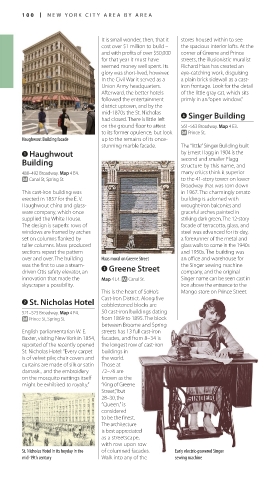
St. Nicholas Hotel in its heyday in the of columned facades. Early electric-powered Singer
mid-19th century Walk into any of the sewing machine
100-101_EW_New_York_City.indd 100 4/3/17 11:11 AM

