


Page 154 - (DK Eyewitness) Travel Guide - New York City
P. 154
152 NE W Y ORK CIT Y AREA B Y AREA
2 Grand Central Terminal
In 1871 Cornelius Vanderbilt (1794–1877)
opened a railway station on 42nd Street.
Although often revamped, it was never large
enough and was finally demolished. The present
station opened in 1913. This Beaux Arts gem has
been a gateway to and symbol of the city ever
since. Its glory is the soaring main concourse and
the way it separates pedestrian and train traffic.
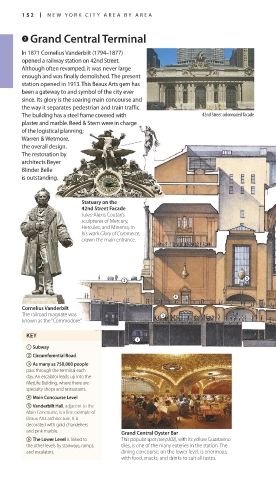
The building has a steel frame covered with 42nd Street colonnaded facade
plaster and marble. Reed & Stern were in charge
of the logistical planning;
Warren & Wetmore,
the overall design.
The restoration by
architects Beyer
Blinder Belle
is outstanding.
Statuary on the
42nd Street Facade
Jules-Alexis Coutan’s
sculptures of Mercury,
Hercules, and Minerva, in
his work Glory of Commerce,
crown the main entrance.
Cornelius Vanderbilt
The railroad magnate was
known as the “Commodore.”
KEY
1 Subway
2 Circumferential Road
3 As many as 750,000 people
pass through the terminal each
day. An escalator leads up into the
MetLife Building, where there are
specialty shops and restaurants.
4 Main Concourse Level
5 Vanderbilt Hall, adjacent to the
Main Concourse, is a fine example of
Beaux Arts architecture. It is
decorated with gold chandeliers
and pink marble. Grand Central Oyster Bar
6 The Lower Level is linked to This popular spot (see p302), with its yellow Guastavino
the other levels by stairways, ramps, tiles, is one of the many eateries in the station. The
and escalators. dining concourse, on the lower level, is enormous,
with food, snacks, and drinks to suit all tastes.
152-153_EW_New_York_City.indd 152 4/3/17 12:08 PM

