


Page 250 - (DK Eyewitness) Travel Guide - New York City
P. 250
248 NE W Y ORK CIT Y AREA B Y AREA
Exploring The Cloisters Museum
Known particularly for its Romanesque and Gothic
architectural sculpture, The Cloisters’ collection also
includes illuminated manuscripts, stained glass,
metalwork, enamels, ivories, and paintings. Among its
tapestries is the renowned Unicorn series. The Cloisters’
splendid medieval complex is unrivaled in North America.
powerful rounded arches
and intricate details. Highly
embellished capitals and
warm, pink marble typify the
12thcentury Cuxa Cloister from
the Pyrenees in France. A griffin,
a dragon, a centaur, and a
basilisk are among the creatures A 16th-century Flemish boxwood rosary
parading over the Narbonne bead from the Treasury
Arch nearby.
In a more solemn style, the Gothic Art
apse from the church of Where Romanesque art
St. Martín in Fuentidueña, was solid, the Gothic style
Spain, is a massive rounded vault that followed (from 1150
A lifesized 12th-century Spanish crucifix constructed from 3,300 blocks of to around 1520) was open,
portraying Christ as the King of Heaven limestone. It is decorated with a with pointed arches, glowing
12thcentury fresco of the Virgin stainedglass windows, and
and Child and has a golden threedimensional sculpture.
Romanesque Art
crowned Christ depicted as Gothic depictions of the Virgin
Fanciful beasts and people, triumphant over death. and Child typically display
acanthus blossoms and scroll More than 800 years ago, exquisite craftsmanship.
work top the columns around Benedictine and Cistercian monks The Gothic Chapel’s
The Cloisters. Many are in the sat on the cold stone benches brilliantly colored windows
Romanesque style that in the Pontaut Chapter House. By show scenes and figures from
flourished in the 11th and 12th the 19th century the building biblical stories. Lifesized tomb
centuries. The museum has had become so neglected that sculptures include the effigy
numerous masterpieces of it was used as a stable. Its of the Crusader knight Jean
Romanesque art and archi ribbed vaulting is a foretaste of d’Alluye. During the 1790s,
tecture, showing the style’s the Gothic style to come. the statue’s original home,
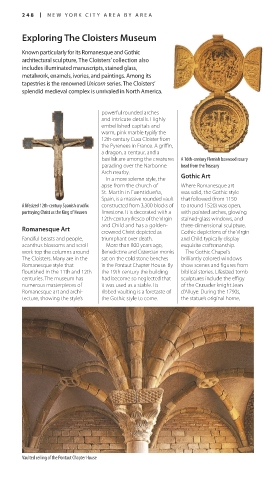
Vaulted ceiling of the Pontaut Chapter House
248-249_EW_New_York_City.indd 248 4/3/17 11:41 AM

