


Page 74 - (DK Eyewitness) Travel Guide - New York City
P. 74
72 NE W Y ORK CIT Y AREA B Y AREA
3 New York Stock Exchange
In 1790, trading in stocks and shares took place
haphazardly on or around Wall Street, but in 1792
24 brokers who traded at 68 Wall Street signed
an agreement to deal only with one another: the
basis of the New York Stock Exchange (NYSE) was
formed. The NYSE has weathered a succession
of alternating slumps (“bear markets”) and
booms (“bull markets”), growing from a local
marketplace into a financial center of global
importance. Membership is strictly limited.
In 1817, a “seat” cost $25; in the “bullish” years
of the late 1990s, the prices ran as high as
$4 million. In 2006, the NYSE became a for-
profit public company, and all the seats were
exchanged for cash and stock settlements.
Traders now buy one-year licenses.
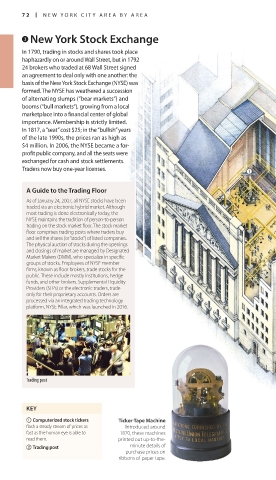
A Guide to the Trading Floor
As of January 24, 2007, all NYSE stocks have been
traded via an electronic hybrid market. Although
most trading is done electronically today, the
NYSE maintains the tradition of person-to-person
trading on the stock market floor. The stock market
floor comprises trading posts where traders buy
and sell the shares (or “stocks”) of listed companies.
The physical auction of stocks during the openings
and closings of market are managed by Designated
Market Makers (DMM), who specialize in specific
groups of stocks. Employees of NYSE member
firms, known as floor brokers, trade stocks for the
public. These include mostly institutions, hedge
funds, and other brokers. Supplemental Liquidity
Providers (SLPs) or the electronic traders, trade
only for their proprietary accounts. Orders are
processed via an integrated trading technology
platform, NYSE Pillar, which was launched in 2016.
Trading post
KEY
1 Computerized stock tickers Ticker-Tape Machine
flash a steady stream of prices as Introduced around
fast as the human eye is able to 1870, these machines
read them. printed out up-to-the-
2 Trading post minute details of
purchase prices on
ribbons of paper tape.
072-073_EW_New_York_City.indd 72 4/3/17 11:10 AM

