


Page 92 - (DK Eyewitness) Travel Guide - New York City
P. 92
90 NE W Y ORK CIT Y AREA B Y AREA
1 Bowery “New York’s finest” came to Street, while the Sicilians stayed
Savings Bank work. During Prohibition, Grand on Elizabeth Street. Mott Street
Street from here to the Bowery was divided between people
130 Bowery. Map 4 F4. was known as “Bootleggers’ from Calabria and Puglia.
q Grand St, Bowery. Row,” and alcohol was easily However, after World War II,
obtained, except when many Italians relocated to the
Imposing inside and a police raid was suburbs and today the district
out, this Classical Revival due. The liquor is much smaller – Mulberry
building was built for merchants paid Street is the only remaining
the Bowery Savings handsomely for a Italian territory.
Bank in 1894. Architect tip-off from inside The most exciting time to visit
Stanford White designed Decorative detail police headquarters. is during the eleven-day Festa di
the ornamented lime- from Bowery The police moved San Gennaro (Feast of San
stone facade to wrap Savings Bank to different head- Gennaro) around September 19
around the rival quarters in 1973, (see p54). Italians from around
Butchers’ and Drovers’ Bank, and in 1987 the building the city meet at Mulberry Street
which refused to sell the corner was converted into a luxury for a wild celebration of the
plot. The interior is decorated apartment project. patron saint of Naples. The street
with marble pillars and a ceiling is full of stalls and Italian
scattered with gilded rosettes. snack vendors, and
By the mid-20th century, there is much music
the bank was a contrast to the and dancing.
Bowery with its vagrants and Many of Little Italy’s
flophouses. It is now the site restaurants offer simple,
of opulent Capitale, and open rustic food served in
only for private functions. friendly surroundings
at reasonable prices.
Some original cafés and
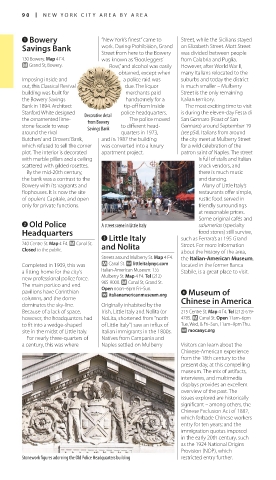
2 Old Police A street scene in Little Italy salumerias (specialty
Headquarters food stores) still survive,
3 Little Italy such as Ferrara’s at 195 Grand
240 Centre St. Map 4 F4. q Canal St. and Nolita Street. For more information
Closed to the public. about the history of the area,
Streets around Mulberry St. Map 4 F4. the Italian-American Museum,
Completed in 1909, this was q Canal St. ∑ littleitalynyc.com located in the former Banca
a fitting home for the city’s Italian-American Museum: 155 Stabile, is a great place to visit.
new professional police force. Mulberry St. Map 4 F4. Tel (212)
The main portico and end 965-9000. q Canal St, Grand St.
Open noon–6pm Fri–Sun.
pavilions have Corinthian ∑ italianamericanmuseum.org 4 Museum of
columns, and the dome Chinese in America
dominates the sky-line. Originally inhabited by the
Because of a lack of space, Irish, Little Italy and Nolita (or 215 Centre St. Map 4 F4. Tel (212) 619-
however, the headquarters had NoLita, shortened from “north 4785. q Canal St. Open 11am–6pm
to fit into a wedge-shaped of Little Italy”) saw an influx of Tue, Wed, & Fri–Sun, 11am–9pm Thu.
site in the midst of Little Italy. Italian immigrants in the 1800s. ∑ mocanyc.org
For nearly three-quarters of Natives from Campania and
a century, this was where Naples settled on Mulberry Visitors can learn about the
Chinese-American experience
from the 18th century to the
present day, at this compelling
museum. The mix of artifacts,
interviews, and multi media
displays provides an excellent
overview of the past. The
issues explored are historically
significant – among others, the
Chinese Exclusion Act of 1882,
which forbade Chinese workers
entry for ten years; and the
immigration quotas imposed
in the early 20th century, such
as the 1924 National Origins
Provision (NOP), which
Stonework figures adorning the Old Police Headquarters building restricted entry further.
090-091_EW_New_York_City.indd 90 4/3/17 11:40 AM

