


Page 40 - Cross Country Travel Guide 2019
P. 40
DENMARK


                                                                                                            Flying the coast
                                                                                                            The wind never stops in Denmark. Pilots fly
                                                                                                            the coast here, often in strong wind on low

                                                                                                            dunes. Sites start to work at 6m/s (20km/h),
                                                                                                            which is lucky as average wind is 7m/s-10m/s.
                                                                                                              This all demands certain skills. You must
                                                                                                            have excellent strong-wind groundhandling,
                                                                                                            and be precise in the air while flying in strong
                                                                                                            wind. Master groundhandling by playing on
                                                                                                            the long sandy beaches.
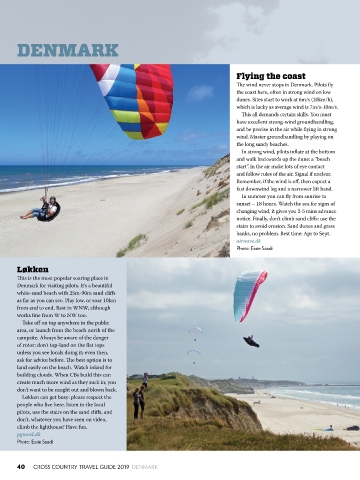
                                                                                                              In strong wind, pilots inflate at the bottom
                                                                                                            and walk backwards up the dune: a “beach
                                                                                                            start”. In the air make lots of eye contact
                                                                                                            and follow rules of the air. Signal if unclear.
                                                                                                            Remember, if the wind is off, then expect a

                                                                                                            fast downwind leg and a narrower lift band.
                                                                                                              In summer you can fly from sunrise to
                                                                                                            sunset – 18 hours. Watch the sea for signs of
                                                                                                            changing wind, it gives you 2-5 mins advance
                                                                                                            notice. Finally, don’t climb sand cliffs: use the
                                                                                                            stairs to avoid erosion. Sand dunes and grass
                                                                                                            banks, no problem. Best time: Apr to Sept.
                                                                                                            airwave.dk
                                                                                                            Photo: Essie Saadi


         Løkken

         This is the most popular soaring place in
         Denmark for visiting pilots. It’s a beautiful
         white-sand beach with 25m-90m sand cliffs
         as far as you can see. Play low, or soar 10km
         from end to end. Best in WNW, although
         works fine from W to NW too.
           Take off on top anywhere in the public
         area, or launch from the beach north of the
         campsite. Always be aware of the danger

         of rotor: don’t top-land on the flat tops
         unless you see locals doing it; even then,
         ask for advice before. The best option is to
         land easily on the beach. Watch inland for
         building clouds. When CBs build this can
         create much more wind as they suck in; you
         don’t want to be caught out and blown back.
           Løkken can get busy: please respect the

         people who live here, listen to the local
         pilots, use the stairs on the sand cliffs, and
         don’t, whatever you have seen on video,
         climb the lighthouse! Have fun.
         pgnord.dk
         Photo: Essie Saadi


         40     CROSS COUNTRY TRAVEL GUIDE 2019  DENMARK

