


Page 33 - Hi-Fi World (January 2020)
P. 33
REVIEW


                regenerated mains power supply fed   this the Stereo 40 MkIV thundered   body was given scale – whilst each
                the electrostatic supplies and Oppo   through tracks like Safri Duo’s   key had solid presence as Volodos
                player, the Icon being connected   Samb Adagio, the opening bell strike   carefully worked his way through this
                to its high current filtered, un-  ringing around our room, followed   lovely piece.  Valve amplifiers always
                regenerated output.         by a swelling synth and then a bass   deliver a big sound – dynamically and
                   The Stereo 40 MkIV was both   synth line that was far and away   spacially – but the Stereo 40 MkIV
                vividly dynamic and spacious in its   more violent than you’d hear from a   has impact,  precision and timing
                sound, Icon Audio getting very clean   transistor amplifier. The combination   beyond most with music such as this.
                bass from their output transformers.   of big, modern power supply, whistle
                The sound was less easy, soft or   clean KT88s and Icon’s massive   CONCLUSION
                warm – as classic valve amplifiers   output transformers come together   Although a “tried and tested classic”
                are imagined to be – more vivid and   here to deliver bass few amplifiers   in design essence, in real life the
                punchy.  The combination of valve   can match. Interestingly, switching   Stereo 40 MkIV is a different beast
                amplifier and electrostatic panel   to L Sensitivity (high feedback)   subjectively. What you get here is
                always was made in heaven, giving   pulls bass back a little, but this   a modern, fast and punchy sound
                a sense of life and scale transistor   is interaction between amplifier   that simply overwhelms most else.
                amplifiers don’t match. But I’ll cover   electrical damping and loudspeaker   With very strong bass, a huge sound
                the sonic options first.    acoustic damping, so no mystery.  stage and thunderous dynamics the
                   With Antonio Forcione’s Tears      Arcadi Volodos playing   Icon is a long way from valve amps
                of Joy (CD) there was softness   – sublimely – Schubert piano   of yore. It’s a great blend of old and
                and warmth in the sound with   concertos (CD) was vivacious,   new, finding the best in both. Add in
                feedback Off (sensitivity 0). Wooden   dynamically strong yet controlled and   the almost unique ability to dial in
                blocks lacked transient edge and   with a lovely light across the sound   feedback and select Triode mode and
                guitar strings were mild rather   stage – bright but honeyed. This   you’ve got an amplifier and a sound
                than lacerative. However,  with no   Icon puts power into piano – the   that’s hard to beat at any price.
                feedback images seemingly jump out,
                having a dynamic about them that’s
                almost puzzling – but that’s because   MEASURED PERFORMANCE
                zero feedback is never encountered
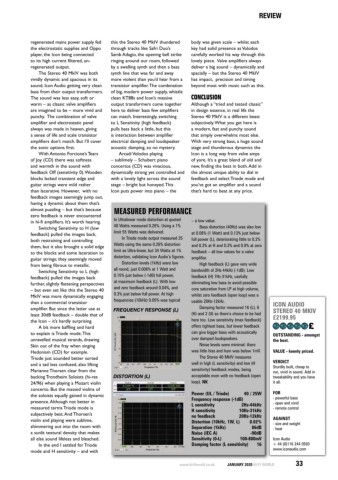
                in hi-fi amplifiers. It’s worth hearing.  In Ultralinear mode distortion at quoted   – a low value.
                   Switching Sensitivity to H (low   40 Watts measured 0.26%. Using a 1%      Bass distortion (40Hz) was also low
                feedback) pulled the images back,   limit 55 Watts was delivered.    at 0.06% (1 Watt) and 0.13% just below
                both restraining and controlling      In Triode mode output measured 25   full power (L), deteriorating little to 0.2%
                them, but it also brought a solid edge   Watts using the same 0.26% distortion   and 0.3% at H and 0.3% and 0.8% at zero
                to the blocks and some laceration to   limit as Ultra-linear, but 34 Watts at 1%   feedback – all low values for a valve
                guitar strings; they seemingly moved   distortion, validating Icon Audio’s figures.  amplifier.
                from being fibrous to metallic.       Distortion levels (1kHz) were low      High feedback (L) gave very wide
                   Switching Sensitivity to L (high   all round, just 0.006% at 1 Watt and   bandwidth of 2Hz-44kHz (-1dB). Low
                feedback) pulled the images back   0.15% just below (-1dB) full power,   feedback (H) 7Hz-31kHz, usefully
                further, slightly flattening perspectives   at maximum feedback (L). With low   eliminating low bass to avoid possible
                – but even set like this the Stereo 40   and zero feedback around 0.04%, and   core saturation from LP at high volume,
                MkIV was more dynamically engaging   0.3% just below full power. At high   whilst zero feedback (open loop) was a
                than a commercial transistor   frequencies (10kHz) 0.05% was typical   usable 20Hz-12kHz.   ICON AUDIO
                amplifier. But since the latter use at   FREQUENCY RESPONSE (L)     Damping factor measured 16 (L), 6   STEREO 40 MKIV
                least 30dB feedback – double that of                     (H) and 2 (0) so there’s choice to be had   £2199.95
                the Icon – it’s hardly surprising.                       here too. Low sensitivity (max feedback)
                   A bit more baffling and hard                          offers tightest bass, but lower feedback   £
                to explain is Triode mode. This                          can give bigger bass with acoustically   OUTSTANDING - amongst
                unravelled musical strands, drawing                      over damped loudspeakers.    the best.
                Skin out of the fray when singing                           Noise levels were minimal: there
                Hedonism (CD) for example.                               was little hiss and hum was below 1mV.  VALUE - keenly priced.
                Triode just sounded better sorted                           The Stereo 40 MkIV measures
                and a tad less confused, also lifting                    well in high (L sensitivity) and low (H   VERDICT
                                                                                                      Sturdily built, cheap to
                Marianne Thorsen clear from the                          sensitivity) feedback modes, being   run, vivid in sound. Add in
                backing Trondheim Soloists (hi-res   DISTORTION (L)      acceptable even with no feedback (open   tweakability and you have
                24/96) when playing a Mozart violin                      loop). NK                    it all.
                concerto. But the massed violins of
                the soloists equally gained in dynamic                   Power (UL / Triode)   40 / 25W  FOR
                                                                                                      - powerful bass
                presence. Although not better in                         Frequency response (-1dB) 2Hz-44kHz  - open and vivid
                                                                         L sensitivity
                measured terms Triode mode is                            H sensitivity    10Hz-31kHz  - remote control
                subjectively best. And Thorsen’s                         no feedback      20Hz-12kHz
                violin and playing were sublime,                         Distortion (10kHz, 1W, L)   0.02%  AGAINST
                shimmering out into the room with                        Separation (1kHz)     86dB   - size and weight
                                                                                                      - heat
                a sunlit textural density that makes                     Noise (IEC A)        -90dB
                all else sound lifeless and bleached.                    Sensitivity (0-L)   100-800mV  Icon Audio
                   In the end I settled for Triode                       Damping factor (L sensitivity)   16  + 44 (0)116 244 0593
                mode and H sensitivity – and with                                                     www.iconaudio.com

                                                                     www.hi-fiworld.co.uk   JANUARY 2020 HI-FI WORLD   33

