


Page 124 - (DK Eyewitness) Travel Guide - Sardinia
P. 124
122 SARDINIA AREA B Y AREA
Exploring Alghero
Despite the considerable damage wrought by Allied
bombardments in World War II, the heart of the old city is,
for the most part, intact and can easily be explored on foot.
The main roads from Bosa (to the south) and Sassari (to the
northwest) lead to the city walls, and the best way to explore
is to leave your car outside and walk around the narrow,
high-sided streets of the old city. Strongly influenced by
Spanish culture, Alghero remains the most Spanish city in
Sardinia. The Alghero dialect is closely related to that of
Catalonia, so much so that since 1970, street signs have
been printed in Italian and Catalan, and you are likely to
hear as much Catalan spoken on the streets as Italian.
P Porta a Terra in Alghero with its unique The old town, Alghero
Piazza Porta a Terra. octagonal form. It is also known
This 14th-century city gate now as the Torre dei Cani (the Dogs’ P Palazzo d’Albis
has a rather stranded air, as most Tower) reflecting its earlier use Piazza Civica (Plaça de la Dressana).
of the associated fortifications as an enclosure for the stray This 16th-century palace with
were demolished to make room dogs of the town. twin lancet windows is also
for present-day Via Sassari. The known as Palazzo de Ferrera. It
gate was once known as Torre P Bastione and Forte de is a rare example of Catalan civic
degli Ebrei (dels Hebreus in la Magdalena architecture, and is famous for
Cata lan), or Tower of the Jews, Around sunset locals and tourists having hosted Charles V in October
because of the alike enjoy the pleasant 1541. The emperor stopped at
contribution made stroll along the sea- Alghero with his fleet on the
by the Jewish front. Starting from way to Algiers, and was very
community to the south, Lungomare flattering in his reactions to the
Catalan king Pietro Dante is followed city. According to tradition, the
III’s conquest of the by Lungomare emperor spoke to the populace
city. The tower was Cristoforo Colombo from the balcony of Palazzo d’Albis,
originally one of two and Lungomare and had the following to say about
gates. A drawbridge Marco Polo, which has the city: “Bonita, por mi fé, y bien
linked Porta a Terra a series of ram parts assentada”. (“Beautiful, by my
and the large Gothic with towers (the Torre faith, and quite solid”) and
arch which is now a A window at di San Giacomo, the told the inhabitants “Estade
war memorial. The Palazzo d’Albis Mirador rampart, the todos caballeros” (“You are all
ground floor, covered Torre de la Polvorera, gentlemen”). The monarch’s
by a stone vault, is now used the Torre de Castilla), leading to sojourn ended with a massive
as a small exhibition centre. the port. Not far from the steps requisition of cattle, which
which run from the seafront to he needed for the Spanish troops.
P Torre di San Giacomo the old Porta a Mare city gate, The animals were then slaughtered
Situated in front of the is Forte de la Magdalena, the after an impromptu bullfight, held
17th-century church of Carmen, city’s most important Spanish by the palazzo in Piazza Civica.
on the waterfront, is the fortification. On its walls a plaque
restored Torre di San Giacomo. commemorates Giuseppe R Cattedrale di Santa Maria
It differs from the other towers Garibaldi’s landing here on Piazza Duomo. Tel 079 97 92 22.
14 August 1855. Open Jul–Aug: 10am–1pm, 7–9:30pm
Mon, Tue & Thu–Sat; Apr–May & Sep–
Oct: 10:30am–1pm, 4–6:30pm Mon,
Tue & Thu–Sat.
The doorway of Alghero’s
Neoclassical Cathedral opens out
onto the small Piazzetta Duomo.
The cathedral, dedicated to Santa
Maria, was first built in the 14th
century. In the mid-1500s the
building was restructured in the
Catalan-inspired late Gothic style.
The unusual octagonal bell tower
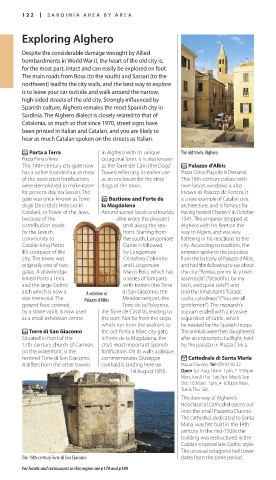
The 15th-century Torre di San Giacomo dates from the same period.
For hotels and restaurants in this region see p178 and p188
122-123_EW_Sardinia.indd 122 11/2/16 12:45 PM
Eyewitness Travel LAYERS PRINTED:
Catalogue template “UK” LAYER
(Source v2.4)
Date 25th April 2013
Size 125mm x 217mm

