


Page 89 - (DK) Super Shark Encyclopedia: And Other Creatures of the Deep
P. 89
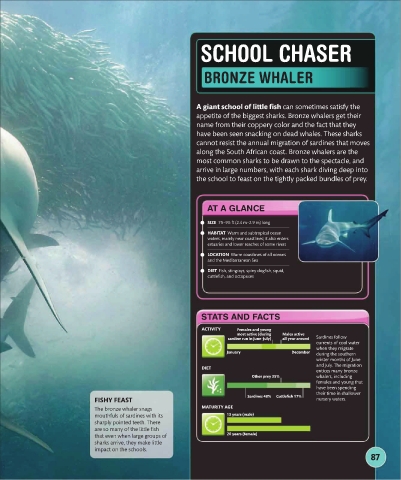
SCHOOL CHASER


                                                                          BRONZE WHALER


                                                                       A giant school of little fish can sometimes satisfy the
                                                                       appetite of the biggest sharks. Bronze whalers get their
                                                                       name from their coppery color and the fact that they
                                                                       have been seen snacking on dead whales. These sharks
                                                                       cannot resist the annual migration of sardines that moves
                                                                       along the South African coast. Bronze whalers are the
                                                                       most common sharks to be drawn to the spectacle, and
                                                                       arrive in large numbers, with each shark diving deep into
                                                                       the school to feast on the tightly packed bundles of prey.


                                                                           AT A GLANCE

                                                                        •  SIZE  7¾–9½ ft (2.4 m–2.9 m) long

                                                                        •  HABITAT  Warm and subtropical ocean
                                                                           waters, mainly near coastlines; it also enters
                                                                           estuaries and lower reaches of some rivers
                                                                        •  LOCATION  Warm coastlines of all oceans
                                                                           and the Mediterranean Sea
                                                                        •  DIET  Fish, stingrays, spiny dogfish, squid,
                                                                           cuttlefish, and octopuses


                                                                         STATS AND FACTS


                                                                         ACTIVITY     Females and young
                                                                                     most active (during   Males active
                                                                                  sardine run in June–July)  all year around  Sardines follow
                                                                                                                  currents of cool water
                                                                                                                  when they migrate
                                                                                  January                December
                                                                                                                  during the southern
                                                                                                                  winter months of June
                                                                                                                  and July. The migration
                                                                         DIET
                                                                                                                  entices many bronze
                                                                                           Other prey 35%         whalers, including
                                                                                                                  females and young that
                                                                                                                  have been spending
                                                                                                                  their time in shallower
                                                                                         Sardines 48%  Cuttlefish 17%
                                   FISHY FEAST                                                                    nursery waters.
                                   The bronze whaler snags               MATURITY AGE
                                   mouthfuls of sardines with its                 13 years (male)
                                   sharply pointed teeth. There
                                   are so many of the little fish
                                   that even when large groups of                 20 years (female)
                                   sharks arrive, they make little
                                   impact on the schools.
                                                                                                                                     87

