


Page 103 - (DK Eyewitness) Travel Guide - Japan
P. 103
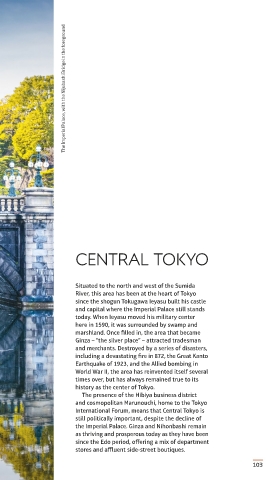
The Imperial Palace, with the Nijubashi Bridge in the foreground


                    CENTRAL TOKYO


                    Situated to the north and west of the Sumida
                    River, this area has been at the heart of Tokyo
                    since the shogun Tokugawa Ieyasu built his castle
                    and capital where the Imperial Palace still stands
                    today. When Ieyasu moved his military center
                    here in 1590, it was surrounded by swamp and
                    marshland. Once filled in, the area that became
                    Ginza – “the silver place” – attracted tradesman
                    and merchants. Destroyed by a series of disasters,
                    including a devastating fire in 872, the Great Kanto
                    Earthquake of 1923, and the Allied bombing in
                    World War II, the area has reinven ted itself several
                    times over, but has always remained true to its
                    history as the center of Tokyo.
                      The presence of the Hibiya business district
                    and cosmopolitan Marunouchi, home to the Tokyo
                    International Forum, means that Central Tokyo is
                    still politically important, despite the decline of
                    the Imperial Palace. Ginza and Nihonbashi remain
                    as thriv ing and prosperous today as they have been
                    since the Edo period, offering a mix of department
                    stores and affluent side-street boutiques.
                                                                  103


   102-103_EW_Japan.indd   103                               04/02/2019   14:54

