


Page 121 - (DK Eyewitness) Travel Guide - Japan
P. 121
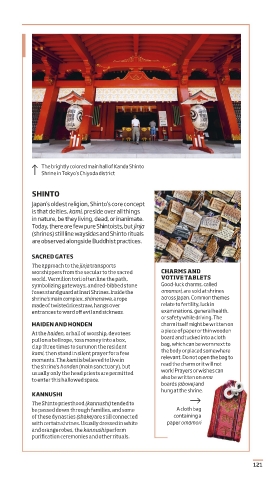
The brightly colored main hall of Kanda Shinto
            Shrine in Tokyo’s Chiyoda district

         SHINTO
         Japan’s oldest religion, Shinto’s core concept
         is that deities, kami, preside over all things
         in nature, be they living, dead, or inanimate.
         Today, there are few pure Shintoists, but jinja
         (shrines) still line waysides and Shinto rituals
         are observed alongside Buddhist practices.
         SACRED GATES
         The approach to the jinja transports
         worshippers from the secular to the sacred   CHARMS AND
         world. Vermilion torii often line the path,   VOTIVE TABLETS
         symbolizing gate ways, and red-bibbed stone   Good-luck charms, called
         foxes stand guard at Inari Shrines. Inside the   omamori, are sold at shrines
         shrine’s main complex, shimenawa, a rope   across Japan. Common themes
         made of twisted rice straw, hangs over   relate to fertility, luck in
         entrances to ward off evil and sickness.  examinations, general health,
                                          or safety while driving. The
         HAIDEN AND HONDEN                charm itself might be written on
                                          a piece of paper or thin wooden
         At the haiden, or hall of worship, devotees   board and tucked into a cloth
         pull on a bell rope, toss money into a box,
         clap three times to summon the resident   bag, which can be worn next to
                                          the body or placed somewhere
         kami, then stand in silent prayer for a few
         moments. The kami is believed to live in     relevant. Do not open the bag to
                                          read the charm or it will not
         the shrine’s honden (main sanctuary), but
         usually only the head priests are permitted   work! Prayers or wishes can
                                          also be written on ema
         to enter this hallowed space.
                                          boards (above) and
                                          hung at the shrine.
         KANNUSHI
         The Shinto priesthood (kannushi) tended to
         be passed down through families, and some   A cloth bag
         of these dynasties (shake) are still connected   containing a
         with certain shrines. Usually dressed in white   paper omamori
         and orange robes, the kannushi perform
         purification ceremonies and other rituals.
                                                                  121


   120-121_EW_Japan.indd   121                               04/02/2019   14:54

