


Page 149 - (DK Eyewitness) Travel Guide - Japan
P. 149
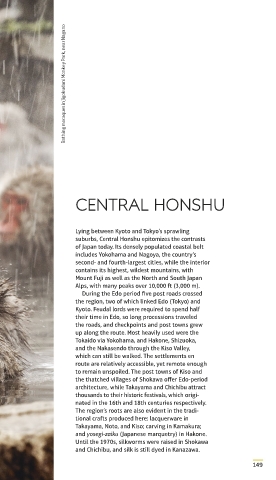
Bathing macaques in Jigokudani Monkey Park, near Nagano


                    CENTRAL HONSHU


                    Lying between Kyoto and Tokyo’s sprawling
                    suburbs, Central Honshu epitomizes the contrasts
                    of Japan today. Its densely populated coastal belt
                    includes Yokohama and Nagoya, the country’s
                    second- and fourth-largest cities, while the interior
                    contains its highest, wildest mountains, with
                    Mount Fuji as well as the North and South Japan
                    Alps, with many peaks over 10,000 ft (3,000 m).
                      During the Edo period five post roads crossed
                    the region, two of which linked Edo (Tokyo) and
                    Kyoto. Feudal lords were required to spend half
                    their time in Edo, so long processions traveled
                    the roads, and checkpoints and post towns grew
                    up along the route. Most heavily used were the
                    Tokaido via Yokohama, and Hakone, Shizuoka,
                    and the Nakasendo through the Kiso Valley,
                    which can still be walked. The settlements en
                    route are relatively accessible, yet remote enough
                    to remain unspoiled. The post towns of Kiso and
                    the thatched villages of Shokawa offer Edo-period
                    architecture, while Takayama and Chichibu attract
                    thousands to their historic festivals, which origi-
                    nated in the 16th and 18th centuries respectively.
                    The region’s roots are also evident in the tradi-
                    tional crafts produced here: lacquerware in
                    Takayama, Noto, and Kiso; carving in Kamakura;
                    and yosegi-zaiku (Japanese marquetry) in Hakone.
                    Until the 1970s, silkworms were raised in Shokawa
                    and Chichibu, and silk is still dyed in Kanazawa.
                                                                  149


   148-149_EW_Japan.indd   149                               04/02/2019   15:57

