


Page 48 - (DK Eyewitness) Travel Guide - Japan
P. 48
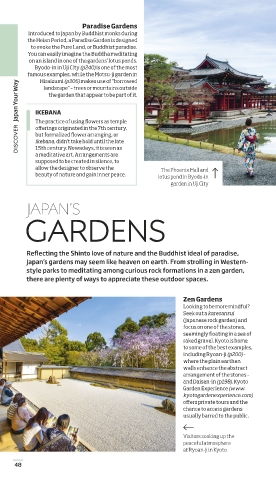
Paradise Gardens
        Introduced to Japan by Buddhist monks during
        the Heian Period, a Paradise Garden is designed
         to evoke the Pure Land, or Buddhist paradise.
        You can easily imagine the Buddha meditating
        on an island in one of the gardens’ lotus ponds.
          Byodo-in in Uji City (p240) is one of the most
        famous examples, while the Motsu-ji garden in
           Hiraizumi (p306) makes use of “borrowed
      DISCOVER  Japan Your Way  The practice of using flowers as temple
            landscape” – trees or mountains outside
             the garden that appear to be part of it.
          IKEBANA

          offerings originated in the 7th century,
          but formalized flower arranging, or
          ikebana, didn’t take hold until the late
          15th century. Nowadays, it is seen as
          a meditative art. Arrangements are
          supposed to be created in silence, to
          allow the designer to observe the   The Phoenix Hall and
          beauty of nature and gain inner peace.   lotus pond in Byodo-in
                                             garden in Uji City

        JAPAN’S
       GARDENS


        Reflecting the Shinto love of nature and the Buddhist ideal of paradise,
        Japan’s gardens may seem like heaven on earth. From strolling in Western-
        style parks to meditating among curious rock formations in a zen garden,
        there are plenty of ways to appreciate these outdoor spaces.

                                                Zen Gardens
                                                Looking to be more mindful?
                                                Seek out a karesansui
                                                (Japanese rock garden) and
                                                focus on one of the stones,
                                                seemingly floating in a sea of
                                                raked gravel. Kyoto is home
                                                to some of the best examples,
                                                including Ryoan-ji (p200) –
                                                where the plain earthen
                                                walls enhance the abstract
                                                arrangement of the stones –
                                                and Daisen-in (p198). Kyoto
                                                Garden Experience (www.
                                                kyotogardenexperience.com)
                                                offers private tours and the
                                                chance to access gardens
                                                usually barred to the public.

                                                Visitors soaking up the
                                                peaceful atmosphere
                                                at Ryoan-ji in Kyoto

     48


   048-049_EW_Japan.indd   48                                04/02/2019   15:56


 EW Themes template v1 – 18th May 2018
 Fonts: Posterama Text, Soho Gothic Pro, Soho Pro

