


Page 85 - World of Animals - Issue #30
P. 85
Sichuan saviours
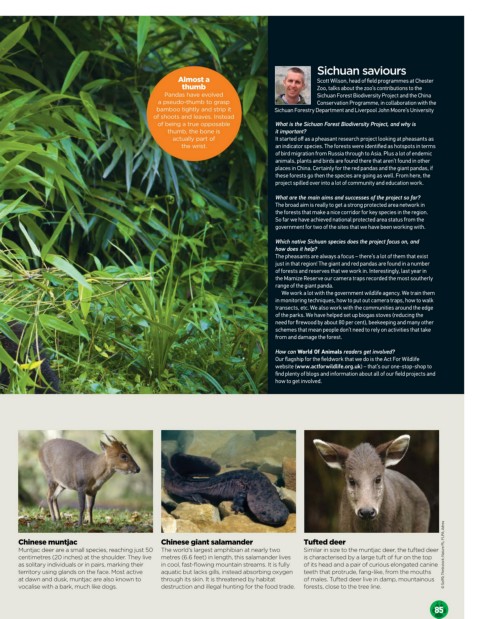
                                                      Almost a                             Scott Wilson, head of field programmes at Chester
                                                       thumb                               Zoo, talks about the zoo’s contributions to the
                                                  Pandas have evolved                      Sichuan Forest Biodiversity Project and the China
                                                a pseudo-thumb to grasp                    Conservation Programme, in collaboration with the
                                                bamboo tightly and strip it     Sichuan Forestry Department and Liverpool John Moore’s University
                                               of shoots and leaves. Instead
                                                of being a true opposable       What is the Sichuan Forest Biodiversity Project, and why is
                                                   thumb, the bone is           it important?
                                                    actually part of            It started off as a pheasant research project looking at pheasants as
                                                      the wrist.                an indicator species. The forests were identified as hotspots in terms
                                                                                of bird migration from Russia through to Asia. Plus a lot of endemic
                                                                                animals, plants and birds are found there that aren’t found in other
                                                                                places in China. Certainly for the red pandas and the giant pandas, if
                                                                                these forests go then the species are going as well. From here, the
                                                                                project spilled over into a lot of community and education work.
                                                                                What are the main aims and successes of the project so far?
                                                                                The broad aim is really to get a strong protected area network in
                                                                                the forests that make a nice corridor for key species in the region.
                                                                                So far we have achieved national protected area status from the
                                                                                government for two of the sites that we have been working with.

                                                                                Which native Sichuan species does the project focus on, and
                                                                                how does it help?
                                                                                The pheasants are always a focus – there’s a lot of them that exist
                                                                                just in that region! The giant and red pandas are found in a number
                                                                                of forests and reserves that we work in. Interestingly, last year in
                                                                                the Mamize Reserve our camera traps recorded the most southerly
                                                                                range of the giant panda.
                                                                                  We work a lot with the government wildlife agency. We train them
                                                                                in monitoring techniques, how to put out camera traps, how to walk
                                                                                transects, etc. We also work with the communities around the edge
                                                                                of the parks. We have helped set up biogas stoves (reducing the
                                                                                need for firewood by about 80 per cent), beekeeping and many other
                                                                                schemes that mean people don’t need to rely on activities that take
                                                                                from and damage the forest.
                                                                                How can World Of Animals readers get involved?
                                                                                Our flagship for the fieldwork that we do is the Act For Wildlife
                                                                                website (www.actforwildlife.org.uk) – that’s our one-stop-shop to
                                                                                find plenty of blogs and information about all of our field projects and
                                                                                how to get involved.


          Chinese muntjac                        Chinese giant salamander               Tufted deer
          Muntjac deer are a small species, reaching just 50   The world’s largest amphibian at nearly two   Similar in size to the muntjac deer, the tufted deer
          centimetres (20 inches) at the shoulder. They live   metres (6.6 feet) in length, this salamander lives   is characterised by a large tuft of fur on the top  © Sol90; Thinkstock; Nature PL; FLPA; Adrea
          as solitary individuals or in pairs, marking their   in cool, fast-flowing mountain streams. It is fully   of its head and a pair of curious elongated canine
          territory using glands on the face. Most active   aquatic but lacks gills, instead absorbing oxygen   teeth that protrude, fang-like, from the mouths
          at dawn and dusk, muntjac are also known to   through its skin. It is threatened by habitat   of males. Tufted deer live in damp, mountainous
          vocalise with a bark, much like dogs.  destruction and illegal hunting for the food trade.   forests, close to the tree line.


                                                                                                                           85


   080-085_SichuanForest.indd   85                                                                                       03/02/2016   16:24

