


Page 85 - Forbes India (December 2015)
P. 85
and sub Antarctic islands. Those who
actually want to venture into the
Antarctic slopes need to acclimatise
before embarking on the trek.
“For acclimatising and doing pre-
Antarctica training, the Southern Alps
are certainly a favoured destination
for those who can afford the long
travel,” says Tashi. One of the world’s
most popular mountain ranges—it
is also where several well-known
mountaineering movies, including
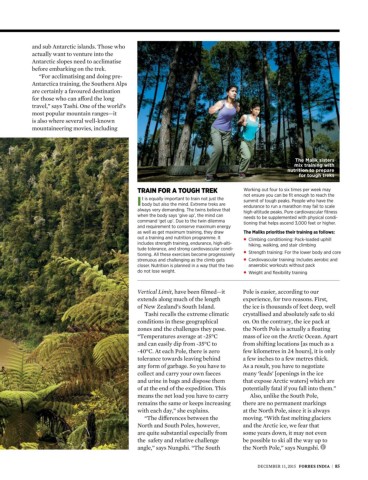
The Malik sisters
mix training with
nutrition to prepare
for tough treks
train For a touGh trek Working out four to six times per week may
t is equally important to train not just the not ensure you can be fit enough to reach the
summit of tough peaks. People who have the
i body but also the mind. Extreme treks are endurance to run a marathon may fail to scale
always very demanding. The twins believe that high-altitude peaks. Pure cardiovascular fitness
when the body says ‘give up’, the mind can needs to be supplemented with physical condi-
command ‘get up’. Due to the twin dilemma tioning that helps ascend 3,000 feet or higher.
and requirement to conserve maximum energy
as well as get maximum training, they draw the Maliks prioritise their training as follows:
out a training and nutrition programme. It Climbing conditioning: Pack-loaded uphill
includes strength training, endurance, high-alti- hiking, walking, and stair climbing
tude tolerance, and strong cardiovascular condi-
tioning. All these exercises become progressively Strength training: For the lower body and core
strenuous and challenging as the climb gets Cardiovascular training: Includes aerobic and
closer. Nutrition is planned in a way that the two anaerobic workouts without pack
do not lose weight. Weight and flexibility training
Vertical Limit, have been filmed—it Pole is easier, according to our
extends along much of the length experience, for two reasons. First,
of New Zealand’s South Island. the ice is thousands of feet deep, well
Tashi recalls the extreme climatic crystallised and absolutely safe to ski
conditions in these geographical on. On the contrary, the ice pack at
zones and the challenges they pose. the North Pole is actually a floating
“Temperatures average at -25°C mass of ice on the Arctic Ocean. Apart
and can easily dip from -35°C to from shifting locations [as much as a
-40°C. At each Pole, there is zero few kilometres in 24 hours], it is only
tolerance towards leaving behind a few inches to a few metres thick.
any form of garbage. So you have to As a result, you have to negotiate
collect and carry your own faeces many ‘leads’ [openings in the ice
and urine in bags and dispose them that expose Arctic waters] which are
of at the end of the expedition. This potentially fatal if you fall into them.”
means the net load you have to carry Also, unlike the South Pole,
remains the same or keeps increasing there are no permanent markings
with each day,” she explains. at the North Pole, since it is always
“The differences between the moving. “With fast melting glaciers
North and South Poles, however, and the Arctic ice, we fear that
are quite substantial especially from some years down, it may not even
the safety and relative challenge be possible to ski all the way up to
angle,” says Nungshi. “The South the North Pole,” says Nungshi.
DECEMBER 11, 2015 FORBES INDIA | 85

