


Page 114 - (DK Eyewitness) Travel Guide - 15-minute Italian
P. 114
112    WE E K 11
                          VENIRE
         Warm up (1minute)
       Say the days of the week  To come
       in Italian. (pp.28–9)  The verb venire (to come (to come (  ) is a very common verb
       How do you say     that can be used to make a variety of useful idiomatic
       “cleaner”? (pp.110–11)  expressions. Remember that in Italian, the sense of
       Say “It’s 9:30,” “10:45,”   continuing action is implied in the simple present
       “12:00.” (pp.30–1)  tense—for example, vengo can mean both
                          I come and I am coming.


         Venire: to come (6 minutes)
       Say the different forms of venire (to come (to come (  ) aloud.
       Use the cover flap to test yourself and, when you
       are confident, practice the sample sentences below.

                  (io) vengo  I come
               (ee-oh) vengoh
                  (tu) vieni  you come
                 (too) vyenee  (informal singular)
                  (lei) viene  you come
                 (lay) vyenay  (formal singular)
               (lui/lei) viene  he/she/it comes
            (loo-ee/lay) vyenay
               (noi) veniamo  we come
              (noy) veneeamoh
                 (voi) venite  you come
                (voy) veneetay  (plural)
              (loro) vengono  they come
              (loroh) vengonoh
        Veniamo tutte le estati.  We come
            veneeamoh toottay  every summer.
                  lay estatee
              Vengo anch’io.  I am coming, too.
              vengoh ankeeoh
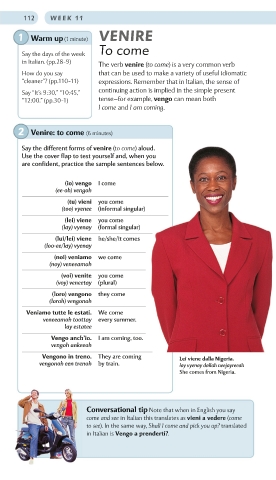
            Vengono in treno.  They are coming   Lei viene dalla Nigeria.
           vengonoh een trenoh  by train.      lay vyenay dallah neejayreeah
                                               She comes from Nigeria.


                       Conversational tip Note that when in English you say
                       come and see in Italian this translates as vieni a vedere (come
                       to see). In the same way, Shall I come and pick you up? translated Shall I come and pick you up? translated Shall I come and pick you up?
                       in Italian is Vengo a prenderti?.

