


Page 42 - (DK Eyewitness) Travel Guide - 15-minute Italian
P. 42
40    WE E K 4
                          ANDARE E PRENDERE
         Warm up (1minute)
                          To go and to take
       How do you say “train”?
       (pp.38–9)
                          Andare (to go (to go (  ) and prendere (to take (to take (  ) are essential
       What does “Da quale   verbs in Italian that you will need to use frequently in
       binario parte il treno?”   everyday conversation as you find your way around.
       mean? (pp.38–9)    You can also use prendere when you talk about food
       Ask “When are you   and drink—for example, to say prendo un caffè
       free?” (pp.32–3)   (I’ll have a coffee).


         Andare: to go (6 minutes)
       Say the different forms of andare (to go (to go (  ) aloud. Use the
       cover flaps to test yourself and, when you are
       confident, practice the sample sentences below.
                   (io) vado  I go
                 (eeoh) vadoh
                    (tu) vai  you go (informal
                  (too) vaee  singular)
                    (Lei) va  you go (formal singular)
                   (lay) vah
                  (lui/lei) va  he/she/it goes
               (looee/lay) vah
               (noi) andiamo  we go
              (noy) andeeamoh
                (voi) andate
                (voy) andatay  you go (plural)


                (loro) vanno  they go
               (loroh) vannoh
            Dove va, signora?  Where are you
          dovay vah, seennyorah  going, madam?
        Vorrei andare in treno.  I’d like to go by train.  Vado a Pisa.
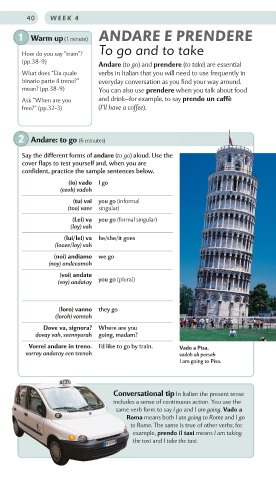
        vorray andaray een trenoh              vadoh ah peesah
                                               I am going to Pisa.


                              Conversational tip In Italian the present tense
                              includes a sense of continuous action. You use the
                               same verb form to say I go and I am going. Vado a
                                  Roma means both I am going to Rome and I go
                                   to Rome. The same is true of other verbs; for
                                   example, prendo il taxi means I am taking
                                   the taxi and I take the taxi.

