


Page 129 - (DK Eyewitness) Travel Guide - Ireland
P. 129
IRELAND A T A GLANCE 127
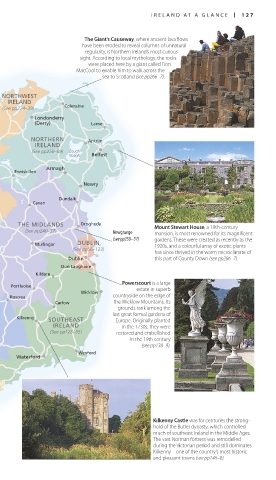
The Giant’s Causeway, where ancient lava flows
have been eroded to reveal columns of unnatural
regularity, is Northern Ireland’s most curious
sight. According to local mythology, the rocks
were placed here by a giant called Finn
MacCool to enable him to walk across the
sea to Scotland (see pp266–7).
NORTHWEST
IRELAND
(See pp224–39) Coleraine
Londonderry
(Derry) Larne
NORTHERN Antrim
Donegal
IRELAND
(See pp258–89) Lough
Neagh Belfast
Armagh
Enniskillen
Sligo
Newry
Ballina
Lough
Allen Dundalk
Cavan
Boyle
Westport
THE WEST THE MIDLANDS Drogheda Mount Stewart House, a 19th-century
Lough OF IRELAND (See pp240–57) Newgrange mansion, is most renowned for its magnificent
Mask (See pp204–23) (see pp250–51) gardens. These were created as recently as the
Mullingar DUBLIN 1920s, and a colourful array of exotic plants
Lough (See pp56–123)
Corrib Athlone has since thrived in the warm microclimate of
Dublin this part of County Down (see pp286–7).
Galway Dun Laoghaire
Kildare
Powerscourt is a large
Portlaoise
Wicklow estate in superb
THE LOWER Roscrea countryside on the edge of
the Wicklow Mountains. Its
SHANNON Carlow
(See pp184–203) grounds rank among the
Shannon Kilkenny last great formal gardens of
Limerick SOUTHEAST Europe. Originally planted
IRELAND in the 1730s, they were
(See pp128–55) restored and embellished
Tipperary in the 19th century
(see pp138–9).
Tralee Wexford
Waterford
Mallow
Killarney
Cork
CORK AND KERRY
(See pp156–83)
Kilkenny Castle was for centuries the strong-
hold of the Butler dynasty, which controlled
much of southeast Ireland in the Middle Ages.
The vast Norman fortress was remodelled
during the Victorian period and still dominates
Kilkenny – one of the country’s most historic
and pleasant towns (see pp146–8).
126-127_EW_Ireland.indd 127 25/04/16 11:01 am

