


Page 225 - (DK Eyewitness) Travel Guide - Ireland
P. 225
THE WEST OF IRELAND 223
village of Strokestown itself. The Great Famine
By 1979, the estate’s original
12,000 ha (30,000 acres) had The failure of the Irish potato crop in 1845, 1846 and 1848, due
dwindled to 120 ha (300 acres), to potato blight, had disastrous consequences for the people of
but the re creation of the Ireland, many of whom relied on this staple crop. More than a million
Pleasure Gardens and the Fruit died of starvation and disease, and by 1856 over two and a half
and Vegetable Garden have million had been forced to emigrate. The crisis was worsened by
greatly increased the area. unsympathetic landlords who often continued collecting rents. The
Famine had far-reaching effects: mass emigration became a way of
Set in the stable yards, the life (see pp46–7) and many rural communities, particularly in the far
Famine Museum uses the west, were decimated.
Strokestown archives to tell the
story of tenants and land lords
during the 1840s Famine.
During the crisis, landlords
divided into two camps: the
charitable, some of whom
started up Famine Relief
schemes, and the callous, like
the Mahons of Strokestown.
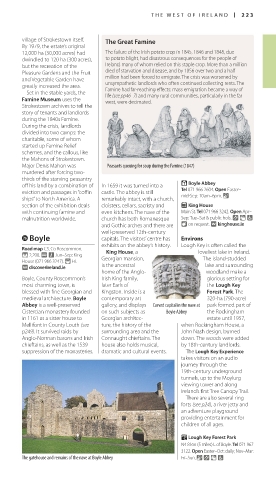
Major Denis Mahon was Peasants queuing for soup during the Famine (1847)
murdered after forcing two-
thirds of the starving peasantry R Boyle Abbey
off his land by a combination of In 1659 it was turned into a
eviction and passages in “coffin castle. The abbey is still Tel 071 966 2604. Open Easter–
mid-Sep: 10am–6pm. &
ships” to North America. A remarkably intact, with a church,
section of the exhibition deals cloisters, cellars, sac risty and E King House
with continuing famine and even kitchens. The nave of the Main St. Tel 071 966 3242. Open Apr–
malnutrition worldwide. church has both Romanesque Sep: Tue–Sat & public hols. 0 = 7
and Gothic arches and there are 8 on request. ∑ kinghouse.ie
well-preserved 12th-century
h Boyle capitals. The visitors’ centre has Environs
exhibits on the abbey’s history. Lough Key is often called the
Road map C3. Co Roscommon.
* 2,200. @ n Jun–Sep: King King House, a loveliest lake in Ireland.
House (071 966 3247). ( Fri. Georgian mansion, The island-studded
∑ discoverireland.ie is the ances tral lake and surrounding
home of the Anglo- woodland make a
Boyle, County Roscommon’s Irish King family, glorious setting for
most charming town, is later Earls of the Lough Key
blessed with fine Georgian and Kingston. Inside is a Forest Park. The
medieval architecture. Boyle contem porary art 320-ha (790-acre)
Abbey is a well-preserved gallery, and displays Carved capital in the nave at park formed part of
Cistercian monastery founded on such subjects as Boyle Abbey the Rocking ham
in 1161 as a sister house to Georgian architec- estate until 1957,
Mellifont in County Louth (see ture, the his tory of the when Rockingham House, a
p249). It survived raids by surrounding area and the John Nash design, burned
Anglo-Norman barons and Irish Connaught chieftains. The down. The woods were added
chieftains, as well as the 1539 house also holds musical, by 18th-century landlords.
suppression of the monasteries. dramatic and cultural events. The Lough Key Experience
takes visitors on an audio
journey through the
19th-century underground
tunnels, up to the Moylurg
viewing tower and along
Ireland’s first Tree Canopy Trail.
There are also several ring
forts (see p24), a river jetty and
an adventure playground
providing entertainment for
children of all ages.
} Lough Key Forest Park
N4 8 km (5 miles) E of Boyle. Tel 071 967
3122. Open Easter–Oct: daily; Nov–Mar:
The gatehouse and remains of the nave at Boyle Abbey Fri–Sun. & 0 = 7
222-223_EW_Ireland.indd 223 08/03/17 11:07 am

