


Page 274 - (DK Eyewitness) Travel Guide - Ireland
P. 274
272 IRELAND REGION B Y REGION
R Ardboe Old Cross
Off B73, 16 km (10 miles)
E of Cookstown.
P Wellbrook Beetling Mill
Off A505, 6.5 km (4 miles) W of Cooks-
town. Tel 028 8674 8210. Open mid-
Mar–Jun & Sep: Sat & Sun pm;
Jul–Aug: Thu–Sun pm. Closed Sep–
Mar. & ∑ nationaltrust.org.uk
e Beaghmore
Stone Circles
Road map D2. Co Tyrone. Off A505,
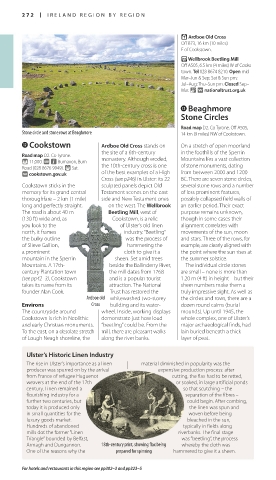
Stone circle and stone rows at Beaghmore 14 km (9 miles) NW of Cookstown.
w Cookstown Ardboe Old Cross stands on On a stretch of open moor land
the site of a 6th-century in the foothills of the Sperrin
Road map D2. Co Tyrone.
* 11,000. @ n Burnavon, Burn monastery. Although eroded, Mountains lies a vast collection
Road (028 8676 9949). ( Sat. the 10th-century cross is one of stone monuments, dating
∑ cookstown.gov.uk of the best examples of a High from between 2000 and 1200
Cross (see p246) in Ulster: its 22 BC. There are seven stone circles,
Cookstown sticks in the sculpted panels depict Old several stone rows and a number
memory for its grand central Testament scenes on the east of less prominent features,
thoroughfare – 2 km (1 mile) side and New Testament ones possibly collapsed field walls of
long and perfectly straight. on the west. The Wellbrook an earlier period. Their exact
The road is about 40 m Beetling Mill, west of purpose remains unknown,
(130 ft) wide and, as Cookstown, is a relic though in some cases their
you look to the of Ulster’s old linen alignment correlates with
north, it frames industry. “Beetling” movements of the sun, moon
the bulky outline was the process of and stars. Three of the rows, for
of Slieve Gallion, hammering the example, are clearly aligned with
a prominent cloth to give it a the point where the sun rises at
mountain in the Sperrin sheen. Set amid trees the summer solstice.
Mountains. A 17th- beside the Ballinderry River, The individual circle stones
century Plantation town the mill dates from 1768 are small – none is more than
(see pp42–3), Cookstown and is a popular tourist 1.20 m (4 ft) in height – but their
takes its name from its attraction. The National sheer numbers make them a
founder Alan Cook. Trust has restored the truly impressive sight. As well as
Ardboe old whitewashed two-storey the circles and rows, there are a
Environs Cross building and its water- dozen round cairns (burial
The countryside around wheel. Inside, working displays mounds). Up until 1945, the
Cookstown is rich in Neolithic demonstrate just how loud whole complex, one of Ulster’s
and early Christian monuments. “beetling” could be. From the major archaeological finds, had
To the east, on a desolate stretch mill, there are pleasant walks lain buried beneath a thick
of Lough Neagh shore line, the along the river banks. layer of peat.
Ulster’s Historic Linen Industry
The rise in Ulster’s importance as a linen material diminished in popularity was the
producer was spurred on by the arrival expensive production process: after
from France of refugee Huguenot cutting, the flax had to be retted,
weavers at the end of the 17th or soaked, in large artificial ponds
century. Linen remained a so that scutching – the
flourishing industry for a separation of the fibres –
further two centuries, but could begin. After combing,
today it is produced only the linen was spun and
in small quantities for the woven before being
luxury goods market. bleached in the sun,
Hundreds of abandoned typically in fields along
mills dot the former “Linen riverbanks. The final stage
Triangle” bounded by Belfast, was “beetling”, the process
Armagh and Dungannon. 18th-century print, showing flax being whereby the cloth was
One of the reasons why the prepared for spinning hammered to give it a sheen.
For hotels and restaurants in this region see pp302–3 and pp323–5
272-273_EW_Ireland.indd 272 08/03/17 11:08 am
Eyewitness Travel LAYERS PRINTED:
Catalogue template “UK” LAYER
(Source v2)
Date 14th November 2012
Size 125mm x 217mm

