


Page 72 - Forbes - Asia (April 2019)
P. 72
FORBES LIFE


           Clark, one of the greatest Formula 1 drivers of all time, and was       Once the design is set, it is meticulously scaled down to
           an enthusiastic slot-car racer at age 15. “My passion for 1960s      bring the details to life in miniature. Molds are created for the
           Formula 1—and car design in general—was just waiting to              individual parts, and metal, carbon fiber or rubber is used to
           find an outlet,” he says. “We got the opportunity to make a first    create each piece of the puzzle, while some are produced by
           model under license [the Jordan 196], then got a deal with Wil-      3-D printers.
           liams Formula 1 in 1996 and finally with Ferrari in 1998.”              After the parts are cast, they are washed, cleaned and
              In 2004, Amalgam split into two entities: Amalgam Mod-            sanded. Then each set of parts goes through a fettling and fit-
           elmakers and Amalgam Fine Model Cars; one team made                  ting process to ensure they go together perfectly. Afterward,
           one-off architectural models and the other produced scores           the models are primed, spray-painted and polished. Decals
           of miniature cars. “I had ambitions to build a brand making          and printed finishes are applied, then subassemblies such as
           the best model cars in the world,” Copeman says. “That in-           engines, wheel hubs and suspensions are built, followed by
           volved a degree of risk taking and a mission not shared with         final assembly. “About 90% of the skills we use are very tradi-
           my partners.” The two companies remain deeply connect-               tional,” Copeman says of the process, most of which is done
           ed, though. “We operated out of the same building for sever-         by hand and which he likens to fine watchmaking. “Ten per-
           al years and are still good friends today,” he insists. But Cope-    cent are modern.”
           man has no financial interest in the original company. “We do           Producing the design molds takes between 2,500 hours
           share ownership of our original workshop,” he adds.                  (for, say, open-wheel racers) to 4,500 hours for complex
              From 2006 to 2007, Ferra-                                                                     classics, and it takes another
           ri’s then-president, Luca Corde-                                                                 250 to 450 hours to make each
           ro di Montezemolo, commissioned                                                                  model. “For example,” Copeman
           Amalgam to make miniatures of                                                                    says, “The Ferrari LaFerrari takes
           current and classic road-going Fer-                                                              about 3,500 hours to develop and
           raris. “We started with the 250TR,                                                               another 350 to build.”
           as opposed to the GTO,” says Cope-                                                                   Amalgam’s elite clientele still
           man. “A Scaglietti car.” It took some                                                            consists of Formula 1 teams, driv-
           time, but Lamborghini, McLar-                                                                    ers and managers, but it also in-
           en and other automakers eventual-                                                                cludes famous collectors. Sylvester
           ly wanted models of their vehicles                                                               Stallone bought a limited edition
           as well. That’s when business real-                                                              1:8-scale Ferrari F1 car from the
           ly took off.                                                                                     early-2000s Michael Schumacher
              Today the company, which                                                                      era. Ralph Lauren commissioned
           Copeman renamed Amalgam                                                                          17 models of cars from his collec-
           Collection in 2016, has revenues                                                                 tion while they were on display
           around $10 million a year, build-                                                                at the Musée des Arts Décora-
           ing more than 500 models a month                                                                 tifs in Paris, including a Jaguar D-
           that range in price from $685 to                                                                 Type, like the model whose shark
           upwards of $150,000, depending                                                                   fin blazed a triumphant trail at
           on size and the amount of detail.                                                                Le Mans in 1955, 1956 and 1957.
           It employs more than 200 people                                                                   Swiss watchmaker Richard Mille
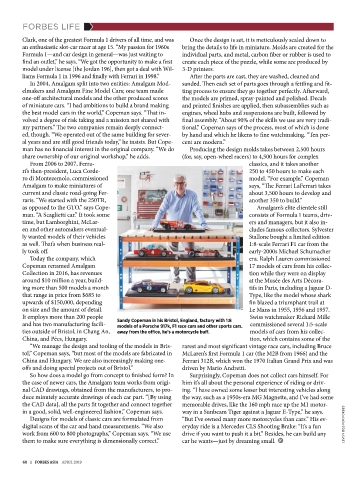
                                                    Sandy Copeman in his Bristol, England, factory with 1:8
           and has two manufacturing facili-        models of a Porsche 917k, F1 race cars and other sports cars.   commissioned several 1:5-scale
           ties outside of Bristol, in Chang An,    away from the office, he’s a motorcycle buff.            models of cars from his collec-
           China, and Pécs, Hungary.                                                                         tion, which contains some of the
              “We manage the design and tooling of the models in Bris-          rarest and most significant vintage race cars, including Bruce
           tol,” Copeman says, “but most of the models are fabricated in        McLaren’s first Formula 1 car (the M2B from 1966) and the
           China and Hungary. We are also increasingly making one-              Ferrari 312B, which won the 1970 Italian Grand Prix and was
           offs and doing special projects out of Bristol.”                     driven by Mario Andretti.
              So how does a model go from concept to finished form? In             Surprisingly, Copeman does not collect cars himself. For
           the case of newer cars, the Amalgam team works from origi-           him it’s all about the personal experience of riding or driv-
           nal CAD drawings, obtained from the manufacturers, to pro-           ing. “I have owned some lesser but interesting vehicles along
           duce minutely accurate drawings of each car part. “[By using         the way, such as a 1950s-era MG Magnette, and I’ve had some
           the CAD data], all the parts fit together and connect together       memorable drives, like the 160 mph race up the M1 motor-
           in a good, solid, well-engineered fashion,” Copeman says.            way in a Sunbeam Tiger against a Jaguar E-Type,” he says.
              Designs for models of classic cars are formulated from            “But I’ve owned many more motorcycles than cars.” His ev-
           digital scans of the car and hand measurements. “We also             eryday ride is a Mercedes CLS Shooting Brake: “It’s a fun            LEVON BISS FOR FORBES
           work from 600 to 800 photographs,” Copeman says. “We use             drive if you want to push it a bit.” Besides, he can build any
           them to make sure everything is dimensionally correct.”              car he wants—just by dreaming small. F


           68     |     FORBES ASIA     APRIL 2019

