


Page 89 - Travel + Leisure India & South Asia (January 2020)
P. 89
A $20 (`1,417) wine-tasting, for instance, will get you
                  four wines from the Vaduz Domain as well as those
                  produced on the Wilfersdorf Domain higher in the hills,
                  both part of the prince’s cellar. Royal celebrity spotting is
                  a bonus as the prince is often at the winery himself,
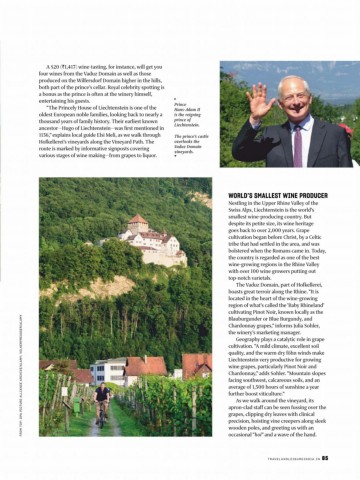
                  entertaining his guests.                                    Prince
                     “The Princely House of Liechtenstein is one of the       Hans-Adam II
                  oldest European noble families, looking back to nearly a    is the reigning
                  thousand years of family history. Their earliest known      prince of
                                                                              Liechtenstein.

                  ancestor—Hugo of Liechtenstein—was first mentioned in
                  1136,” explains local guide Elsi Meli, as we walk through   The prince’s castle
                  Hofkellerei’s vineyards along the Vineyard Path. The        overlooks the
                  route is marked by informative signposts covering           Vaduz Domain
                                                                              vineyards.
                  various stages of wine making—from grapes to liquor.


                                                                                                      WORLD’S SMALLEST WINE PRODUCER

                                                                                                      Nestling in the Upper Rhine Valley of the
                                                                                                      Swiss Alps, Liechtenstein is the world’s
                                                                                                      smallest wine-producing country. But
                                                                                                      despite its petite size, its wine heritage
                                                                                                      goes back to over 2,000 years. Grape
                                                                                                      cultivation began before Christ, by a¡Celtic
                                                                                                      tribe that had settled in the area, and was
                                                                                                      bolstered when the Romans came in. Today,
                                                                                                      the country is regarded as one of the best
                                                                                                      wine-growing regions in the Rhine Valley
                                                                                                      with over 100 wine growers putting out
                                                                                                      top-notch varietals.
                                                                                                         The Vaduz Domain, part of Hofkellerei,
                                                                                                      boasts great terroir along the Rhine. “It is
                                                                                                      located in the heart of the wine-growing
                                                                                                      region of what’s called the ‘Baby Rhineland’
                                                                                                      cultivating Pinot Noir, known locally as the
          FROM TOP: DPA PICTURE ALLIANCE ARCHIVE/ALAMY; VOLKERPREUSSER/ALAMY
                                                                                                      Blauburgunder or Blue Burgundy, and
                                                                                                      Chardonnay grapes,” informs Julia Sohler,
                                                                                                      the winery’s marketing manager.
                                                                                                         Geography plays a catalytic role in grape
                                                                                                      cultivation. “A mild climate, excellent soil
                                                                                                      quality, and the warm¡dry föhn¡winds make
                                                                                                      Liechtenstein very productive for growing
                                                                                                      wine grapes, particularly Pinot Noir and
                                                                                                      Chardonnay,” adds Sohler. “Mountain slopes
                                                                                                      facing southwest, calcareous soils, and an
                                                                                                      average of 1,500 hours of sunshine a year
                                                                                                      further boost viticulture.”
                                                                                                         As we walk around the vineyard, its
                                                                                                      apron-clad staff can be seen fussing over the
                                                                                                      grapes, clipping dry leaves with clinical
                                                                                                      precision, hoisting vine creepers along sleek
                                                                                                      wooden poles, and greeting us with an
                                                                                                      occasional “hoi” and a wave of the hand.


                                                                                                                       TR AV E L A NDLE I S U R E IND I A .IN   85

