


Page 97 - Travel + Leisure India & South Asia (January 2020)
P. 97
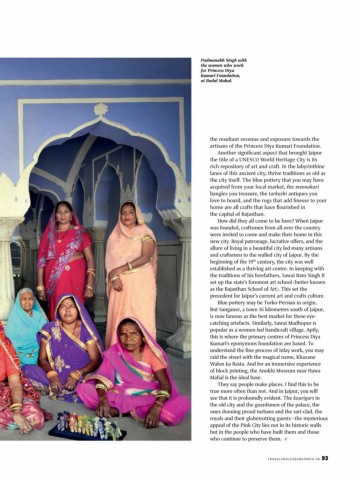
Padmanabh Singh with
                                                                                         the women who work
                                                                                         for Princess Diya
                                                                                         Kumari Foundation,
                                                                                         at Badal Mahal.


                                                                                              the resultant revenue and exposure towards the
                                                                                              artisans of the Princess Diya Kumari Foundation.
                                                                                                 Another significant aspect that brought Jaipur
                                                                                              the title of a UNESCO World Heritage City is its
                                                                                              rich repository of art and craft. In the labyrinthine
                                                                                              lanes of this ancient city, thrive traditions as old as
                                                                                              the city itself. The blue pottery that you may have
                                                                                              acquired from your local market, the meenakari
                                                                                              bangles you treasure, the tarkashi antiques you
                                                                                              love to hoard, and the rugs that add finesse to your
                                                                                              home are all crafts that have flourished in
                                                                                              the capital of Rajasthan.
                                                                                                 How did they all come to be here? When Jaipur
                                                                                              was founded, craftsmen from all over the country
                                                                                              were invited to come and make their home in this
                                                                                              new city. Royal patronage, lucrative offers, and the
                                                                                              allure of living in a beautiful city led many artisans
                                                                                              and craftsmen to the walled city of Jaipur. By the
                                                                                                                 th
                                                                                              beginning of the 19  century, the city was well
                                                                                              established as a thriving art centre. In keeping with
                                                                                              the traditions of his forefathers, Sawai Ram Singh II
                                                                                              set up the state’s foremost art school (better known
                                                                                              as the Rajasthan School of Art). This set the
                                                                                              precedent for Jaipur’s current art and crafts culture.
                                                                                                 Blue pottery may be Turko-Persian in origin.
                                                                                              But Sanganer, a town 16 kilometres south of Jaipur,
                                                                                              is now famous as the best market for these eye-
                                                                                              catching artefacts. Similarly, Sawai Madhopur is
                                                                                              popular as a women-led handicraft village. Aptly,
                                                                                              this is where the primary centres of Princess Diya
                                                                                              Kumari’s eponymous foundation are based. To
                                                                                              understand the fine process of inlay work, you may
                                                                                              raid the street with the magical name, Khazane
                                                                                              Walon ka Rasta. And for an immersive experience
                                                                                              of block printing, the Anokhi Museum near Hawa
                                                                                              Mahal is the ideal base.
                                                                                                 They say people make places. I find this to be
                                                                                              true more often than not. And in Jaipur, you will
                                                                                              see that it is profoundly evident. The kaarigars in
                                                                                              the old city and the guardsmen of the palace, the
                                                                                              ones donning proud turbans and the sari-clad, the
                                                                                              royals and their globetrotting guests—the mysterious
                                                                                              appeal of the Pink City lies not in its historic walls
                                                                                              but in the people who have built them and those
                                                                                              who continue to preserve them.


                                                                                                                       TR AV E L A NDLE I S U R E IND I A .IN   93

