


Page 50 - Today's Dietitian (March 2020)
P. 50
Get to Know …     By Lindsey Getz


                                                                            cultural backgrounds, frustrated
                                                                            Weaver, as the Food Pyramid omits
                                                                            many culturally relevant choices for
                                                                            clients of color and those from different
                                                                            countries. This experience was the
                                                                            catalyst for Weaver to create the Soul
                                                                            Food Pyramid, which used the same
                                                                            dietary guidelines as the Food Pyramid
                                                                            but was tailored to the “culture of the
                                                                            South” with culturally relevant foods.
                                                                            Today, the Soul Food Pyramid has
                                                                            transformed into the Soul Food Plate, a
                                                                            twist on USDA’s MyPlate.
                                                                              Over the years, Hebni has won
                                                                            several major awards, including the
                                                                            Sapphire Award (which is funded by
                                                                            Blue Cross Blue Shield’s Florida Blue
                                                                            Foundation and recognizes “excellence
                                                                            and innovation in community health”)
                                                                            and the Helping Kids Shine Grant
                                                                            for children’s programs from Disney.
                                                                            Weaver says the funding they’ve received
                                                                            over the years from awards and grants
                                                                            has been vital to Hebni’s success. All of
                                                                            Hebni’s programs are grant funded or
                                                                            funded via foundations.
                                                                              Weaver has been a guest lecturer
                                                                            at a variety of seminars, appeared on
                                                                            multiple television programs, and
                                                                            researched, authored, and coauthored
                                                                            four books: The New Soul Food Cookbook
                                                                            for People With Diabetes (now in its
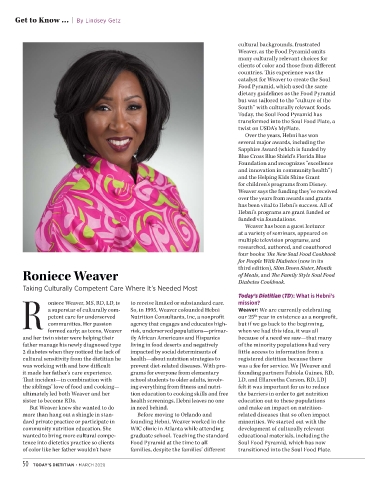
        Roniece Weaver                                                      third edition), Slim Down Sister, Month
                                                                            of Meals, and The Family Style Soul Food
                                                                            Diabetes Cookbook.
        Taking Culturally Competent Care Where It’s Needed Most             Today’s Dietitian (TD): What is Hebni’s
        R       oniece Weaver, MS, RD, LD, is   to receive limited or substandard care.   mission?

                a superstar of culturally com-
                                          So, in 1995, Weaver cofounded Hebni
                                                                            Weaver: We are currently celebrating
                petent care for underserved
                                                                            our 25  year in existence as a nonprofit,
                                                                                 th
                                          Nutrition Consultants, Inc, a nonprofit
                communities. Her passion
                                                                            when we had this idea, it was all
                                          risk, underserved populations—primar-
                formed early; as teens, Weaver   agency that engages and educates high-  but if we go back to the beginning,
        and her twin sister were helping their   ily African Americans and Hispanics   because of a need we saw—that many
        father manage his newly diagnosed type   living in food deserts and negatively   of the minority populations had very
        2 diabetes when they noticed the lack of   impacted by social determinants of   little access to information from a
        cultural sensitivity from the dietitian he   health—about nutrition strategies to   registered dietitian because there
        was working with and how difficult    prevent diet-related diseases. With pro-  was a fee for service. We [Weaver and
        it made her father’s care experience.   grams for everyone from elementary   founding partners Fabiola Gaines, RD,
        That incident—in combination with    school students to older adults, involv-  LD, and Ellareetha Carson, RD, LD]
        the siblings’ love of food and cooking—   ing everything from fitness and nutri-  felt it was important for us to reduce
        ultimately led both Weaver and her   tion education to cooking skills and free   the barriers in order to get nutrition
        sister to become RDs.             health screenings, Hebni leaves no one   education out to these populations
          But Weaver knew she wanted to do   in need behind.                and make an impact on nutrition-
        more than hang out a shingle in stan-  Before moving to Orlando and   related diseases that so often impact
        dard private practice or participate in   founding Hebni, Weaver worked in the   minorities. We started out with the
        community nutrition education. She   WIC clinic in Atlanta while attending   development of culturally relevant
        wanted to bring more cultural compe-  graduate school. Teaching the standard   educational materials, including the
        tence into dietetics practice so clients   Food Pyramid at the time to all   Soul Food Pyramid, which has now
        of color like her father wouldn’t have   families, despite the families’ different   transitioned into the Soul Food Plate.

        50 TODAY’S DIETITIAN • MARCH 2020

